5 Best Open Source API Gateways for Microservices in 2026
A common assumption is that once an application is split into microservices, the networking problem becomes easier. In practice, the opposite can happen. Instead of one application handling requests, you may suddenly have dozens of services, different authentication rules, multiple deployment environments, changing service addresses, and several teams releasing code independently. That is where Open Source API Gateways for Microservices become valuable.
A well-designed gateway gives clients a consistent entry point while taking care of cross-cutting concerns such as routing, authentication, rate limiting, TLS termination, load balancing, and observability.
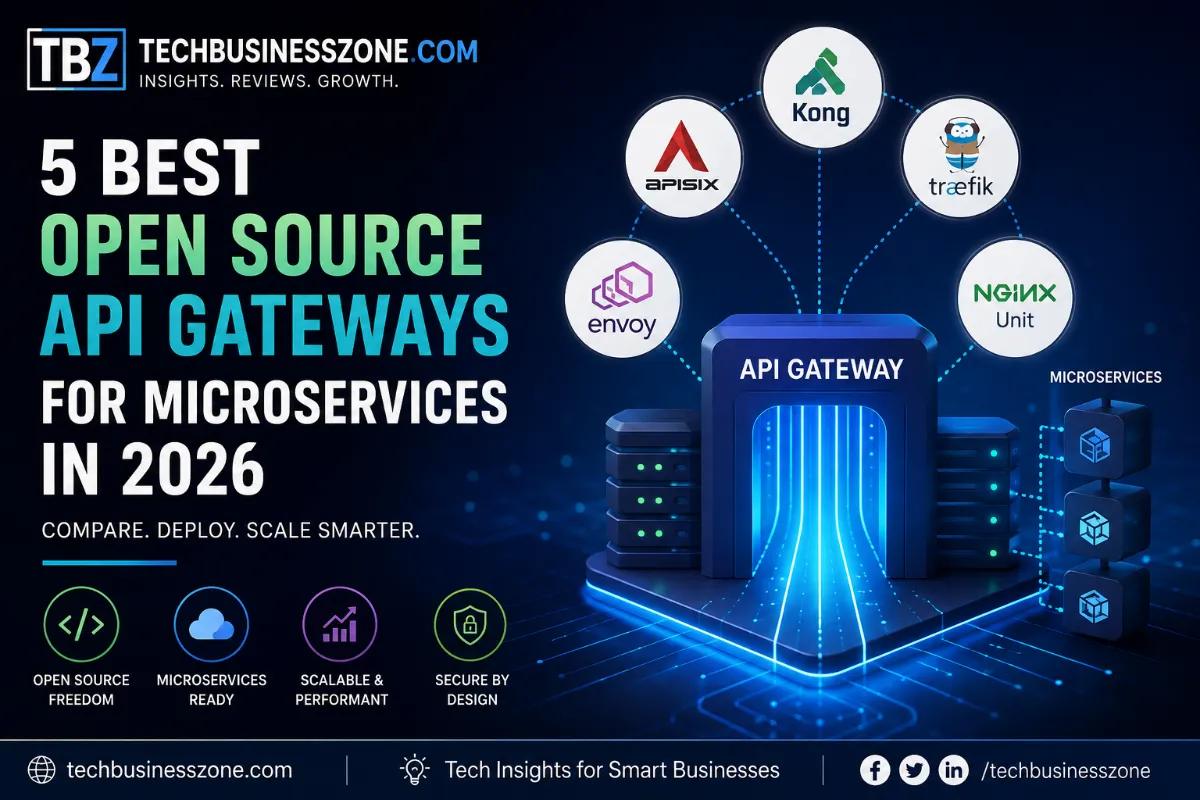
For 2026, five projects stand out for different reasons: Kong Gateway, Apache APISIX, Traefik Proxy, Envoy Proxy, and NGINX Open Source. They are not interchangeable, though. Kong is particularly strong as a full API gateway, APISIX fits dynamic cloud-native environments, Traefik is convenient for containerized deployments, Envoy excels in advanced distributed architectures, and NGINX remains a powerful lightweight foundation.
The right choice depends less on which project has the biggest feature list and more on how your microservices are deployed, how much operational complexity your team can handle, and which API management capabilities you actually need.
AI Overview Direct Answer: What Are the Best Open Source API Gateways for Microservices?
If you need a quick answer, here is the practical shortlist. These Open Source API Gateways for Microservices cover different levels of complexity, from straightforward container routing to sophisticated distributed traffic management.
| API Gateway | Best For | Scalability | Learning Curve | Standout Strength |
|---|---|---|---|---|
| Kong Gateway | Full API management | High | Medium | Plugins and API policies |
| Apache APISIX | Cloud-native microservices | Very high | Medium–High | Dynamic traffic management |
| Traefik Proxy | Docker and Kubernetes | High | Low–Medium | Automatic service discovery |
| Envoy Proxy | Advanced distributed systems | Very high | High | Traffic control and observability |
| NGINX Open Source | Lightweight gateway workloads | High | Medium | Performance and familiarity |
Kong is the strongest all-round option when API management, authentication, traffic policies, and extensibility are priorities. APISIX is particularly compelling for high-performance cloud-native platforms, while Traefik makes sense when automatic discovery is more important than an extensive API-management layer.
Envoy is better suited to engineering organizations comfortable with sophisticated infrastructure, especially when a service mesh is involved. NGINX is a sensible choice when the team already understands NGINX and needs reliable reverse proxying, load balancing, TLS, and routing without introducing a large new platform.
An API gateway generally acts as a single entry point between clients and backend services. It can centralize authentication, authorization, rate limiting, routing, monitoring, logging, and other policies instead of forcing every microservice to implement them independently.
What Is an API Gateway in a Microservices Architecture?
The easiest way to understand an API gateway is to think of it as the traffic controller sitting between consumers and your services. A mobile application, web application, partner integration, or internal client does not necessarily need to know where every backend service lives.
Instead, the client sends a request to the gateway. The gateway evaluates the request, applies the appropriate policies, finds the correct upstream service, and sends the response back.
How an API Gateway Works
A typical request might follow this path:
Client → API Gateway → Authentication → Routing → Microservice → API Gateway → Client
Suppose an e-commerce platform has separate services for users, products, orders, payments, and shipping.
A customer might call:
api.example.com/orders
The gateway can authenticate the request, apply a rate limit, route /orders to the order service, balance the request across healthy instances, record latency and status information, and return the response.
The client does not need to know whether the order service is running on Kubernetes, Docker, a virtual machine, or another cloud environment.
That separation is one of the main reasons Open Source API Gateways for Microservices are useful in distributed applications.
API Gateway vs Reverse Proxy
A reverse proxy and an API gateway overlap, but they are not necessarily the same thing.
NGINX, for example, can operate as a reverse proxy, load balancer, HTTP server, and TCP/UDP proxy. It supports TLS, caching, traffic handling, and other capabilities.
A dedicated API gateway usually goes further into API-specific concerns. It may provide authentication plugins, consumer management, rate limiting, request transformation, API policies, analytics, and more extensive integrations.
The distinction is functional rather than absolute. A sufficiently capable reverse proxy can perform many gateway functions.
API Gateway vs Service Mesh
This distinction becomes important once a microservices platform grows.
An API gateway traditionally manages traffic entering or leaving the application platform. This is often called north-south traffic.
A service mesh focuses primarily on communication between services inside the platform, commonly called east-west traffic.
Envoy is a good example of technology that can participate in both worlds. It can operate as an edge proxy while also handling internal service-to-service traffic. Envoy’s architecture includes service discovery, load balancing, health checking, circuit breaking, and other distributed-system capabilities.
You therefore do not necessarily have to choose between an API gateway and a service mesh. In larger environments, they can complement each other.
Why Microservices Need API Gateways
Microservices create independence, but that independence introduces networking complexity.
Without a gateway, individual services may end up duplicating:
- Authentication
- TLS handling
- Rate limiting
- Request logging
- CORS policies
- Routing logic
- Traffic controls
- Monitoring
- API versioning
Centralizing appropriate cross-cutting concerns can make the architecture easier to operate.
The important word is appropriate. A gateway should not become the place where every piece of application logic is stored.
How We Evaluated the Best Open Source API Gateways in 2026
There is no universal winner among Open Source API Gateways for Microservices. A tool that is excellent for a 10-service Kubernetes environment may be unnecessarily complicated for a small Docker deployment.
For this comparison, the evaluation focuses on practical production requirements rather than benchmark numbers alone.
Core Evaluation Criteria
The major criteria include:
- Open-source availability
- Microservices support
- Kubernetes integration
- Docker support
- Routing capabilities
- Authentication
- Authorization
- Rate limiting
- Load balancing
- TLS management
- Observability
- Extensibility
- Configuration model
- Scalability
- Operational complexity
- Documentation and ecosystem
Kong, for example, provides a plugin architecture that allows standard and custom functionality to be applied at different stages of request processing. Its current documentation also describes custom plugin development through several supported languages and development tools.
APISIX takes a similarly extensible approach, with a large plugin ecosystem and dynamic configuration architecture based around NGINX and etcd.
What Matters Most for Production Microservices
Performance matters, but it should not be the only deciding factor.
A gateway that handles impressive benchmark numbers but is difficult for your team to configure, monitor, upgrade, or troubleshoot can become an operational liability.
Production teams should ask more practical questions:
- Can developers understand the routing model?
- Can configuration be version-controlled?
- Can the gateway survive a backend outage?
- Can you monitor latency and error rates?
- Can authentication policies be applied consistently?
- Can the platform be upgraded without unnecessary downtime?
Those questions often matter more than a benchmark measured under conditions that do not resemble your production traffic.
Personal Experience Narrative: What Real-World API Gateway Deployment Looks Like
The interesting part of deploying Open Source API Gateways for Microservices is that the first successful request is usually the easy part. Getting the gateway to behave predictably under real traffic is where the engineering work begins.
A simple route can take minutes to configure. Production-grade authentication, TLS, observability, failure handling, and configuration management take considerably more thought.
The First Problem Usually Isn’t Routing
Routing tends to be straightforward.
You define a host or path, point it toward an upstream service, and test the request.
The complications appear when the environment changes.
A service may move to another container. Kubernetes may reschedule a pod. A certificate may expire. An upstream service may become slow rather than completely unavailable. A token may be valid but lack the required scope.
Suddenly, the gateway is no longer just forwarding HTTP requests. It is participating in the reliability and security model of the application.
Where Self-Hosted Deployments Become Difficult
Self-hosting gives you control, but it also transfers responsibility to your team.
You have to think about:
- Gateway upgrades
- Configuration backups
- Secrets
- TLS certificates
- Monitoring
- High availability
- Network security
- Administrative interfaces
- Resource limits
- Failure recovery
This is especially relevant with database-backed gateway deployments.
Kong, for example, supports traditional, hybrid, and DB-less deployment approaches. In DB-less mode, configuration is kept in memory and supplied declaratively, which can reduce infrastructure dependencies and work well with Git-based CI/CD workflows.
A Practical Microservices Gateway Workflow
A sensible implementation starts small.
First, put two or three non-critical services behind the gateway. Establish basic routing and HTTPS before introducing a dozen plugins.
Next, add authentication and rate limiting. Then configure centralized logs and metrics.
After that, deliberately break things.
Stop one backend.
Introduce latency.
Send an invalid token.
Exceed the rate limit.
Rotate a certificate.
Restart the gateway.
Those tests tell you much more about the architecture than a successful /health request.
Lessons Learned From Production-Like Testing
One of the most useful principles is to keep gateway configuration reproducible.
If a production gateway depends on undocumented manual changes made through an administrative interface, eventually someone will wonder why staging and production behave differently.
Version-controlled configuration, automated deployment, clear ownership, and meaningful monitoring reduce that risk.
The gateway should also remain boring whenever possible. Its job is to make traffic predictable, not to become another application that requires constant debugging.
Top 5 Best Open Source API Gateways for Microservices in 2026 & onwards
Now we can get to the actual shortlist. Each of these Open Source API Gateways for Microservices has a legitimate place in modern infrastructure, but their strengths are quite different.
1. Kong Gateway — Best Overall Open Source API Gateway
Kong is a strong choice for organizations that want a dedicated API gateway with extensive extensibility.
Its architecture is designed around routing API traffic and extending gateway behavior through plugins. Kong supports deployment patterns ranging from self-managed environments to Kubernetes and hybrid architectures.
Key Kong Features
Kong can provide:
- API routing
- Authentication
- Rate limiting
- Traffic management
- Load balancing
- Request transformation
- Logging
- Monitoring
- Custom plugins
- Kubernetes integration
Its plugin model is one of its biggest advantages. Plugins can be scoped globally or to specific services, routes, consumers, or consumer groups.
That gives platform teams considerable control over where a policy is applied.
Kong for Microservices
Imagine a platform with 30 backend services and several types of consumers.
The gateway can provide a common edge layer while each microservice remains independently deployable.
You can expose selected endpoints, apply authentication to specific routes, rate-limit particular consumers, and maintain policies without modifying every backend application.
That makes Kong particularly attractive when API management is a major requirement rather than a secondary feature.
Kong Deployment Options
Kong offers multiple deployment models.
Traditional mode uses a database for gateway entities. DB-less mode stores configuration in memory and uses declarative configuration. Hybrid mode separates control-plane and data-plane responsibilities, with the control plane handling configuration while data planes process proxy traffic.
That flexibility is useful because different teams have different infrastructure requirements.
A small environment might prefer declarative DB-less configuration. A larger organization may benefit from a more structured control-plane/data-plane architecture.
Best Use Cases for Kong
Kong is particularly suitable for:
- API-centric businesses
- Medium and large engineering teams
- Organizations with multiple API consumers
- Microservices platforms
- Teams needing extensive authentication options
- Environments requiring custom gateway behavior
Kong Limitations
The same flexibility that makes Kong powerful can also make it feel heavy for a small project.
If you have three containers and one public endpoint, you may not need a sophisticated API-management layer.
You also need to understand the differences between deployment modes. DB-less mode, for instance, has limitations around central coordination and plugins that require database-backed functionality.
Verdict: Kong is my strongest general-purpose recommendation when the gateway is expected to become an important part of the API platform.
2. Apache APISIX — Best for High-Performance Cloud-Native Microservices
Apache APISIX has become an especially interesting option for teams building dynamic cloud-native platforms.
It is built on NGINX and etcd and emphasizes dynamic routing, hot configuration updates, traffic management, extensibility, and integrations with cloud-native tooling.
Key Apache APISIX Features
APISIX supports capabilities including:
- Dynamic routing
- Load balancing
- Authentication
- Rate limiting
- Traffic splitting
- Health checks
- Circuit breaking
- Observability
- Kubernetes integration
- Protocol support
- Custom plugins
Its official documentation highlights more than 100 plugins and integrations across observability, authentication, service discovery, Kubernetes, databases, and other infrastructure.
Why APISIX Fits Microservices
The dynamic nature of APISIX is one of its biggest attractions.
Microservices environments change frequently. Services scale up and down. Routes evolve. Traffic policies change.
A gateway that can update configuration dynamically without requiring a full restart is attractive in these environments.
APISIX documentation describes a hot-reloadable plugin pipeline with etcd distributing configuration across the cluster.
APISIX and Kubernetes
The APISIX fits naturally into Kubernetes-based architectures.
Its ingress controller can work with Kubernetes resources and the Gateway API, while the APISIX data plane handles traffic management.
This makes it a compelling option for teams that have already invested heavily in Kubernetes and want an API gateway that can participate deeply in that environment.
Best Use Cases for APISIX
APISIX is particularly attractive for:
- High-volume API platforms
- Kubernetes environments
- Cloud-native applications
- Dynamic routing requirements
- Teams that need extensive traffic control
- Organizations building modern API platforms
APISIX Limitations
The APISIX is not necessarily the easiest gateway for someone who simply wants to expose one Docker container.
Its architecture introduces concepts that need to be understood, especially when you move into larger clustered deployments.
Teams should also distinguish benchmark claims from their own workload. Actual performance depends on request size, plugins, TLS, upstream behavior, network conditions, hardware, and configuration.
Verdict: APISIX is one of the strongest choices for technically mature teams building highly dynamic cloud-native infrastructure.
3. Traefik Proxy — Best for Docker and Kubernetes Environments
Traefik takes a different approach. Its biggest appeal is automatic service discovery.
Rather than manually maintaining every backend route, Traefik can watch infrastructure providers and dynamically update routing when it detects changes. Its current provider model includes Docker, Kubernetes, Consul Catalog, Nomad, and Kubernetes Gateway API support.
Key Traefik Features
Traefik provides:
- Dynamic routing
- Service discovery
- HTTP routing
- TCP routing
- TLS
- Middleware
- Load balancing
- Docker integration
- Kubernetes integration
- Gateway API support
Traefik for Containerized Microservices
This is where Traefik shines.
A Docker-based environment may contain services that appear and disappear as deployments change.
Traefik can watch Docker and use container metadata to construct routing configuration dynamically.
For a development team running several services through Docker Compose, this can feel considerably more natural than maintaining a large static proxy configuration.
Traefik and Kubernetes Ingress
Traefik supports Kubernetes Ingress, CRDs, and the Kubernetes Gateway API. Its current documentation states support for the standard Gateway API v1.5.1 and several associated route types.
That gives teams room to start simply and move toward more structured Kubernetes networking as their platform matures.
Best Use Cases for Traefik
Traefik makes particular sense for:
- Small engineering teams
- Docker-heavy environments
- Kubernetes workloads
- Fast-moving development teams
- Projects where service discovery is important
Traefik Limitations
Traefik’s convenience does not mean you can ignore security.
Its Docker integration can interact directly with the Docker API, and the documentation warns against storing sensitive information such as credentials and certificates in Docker labels.
For larger API-management requirements, a platform such as Kong may provide a better fit.
Verdict: Choose Traefik when you value automatic infrastructure discovery and a relatively approachable operational model.
4. Envoy Proxy — Best for Advanced Cloud-Native Architectures
Envoy is arguably the most technically sophisticated option on this list.
It was designed as a high-performance proxy for cloud-native applications and can handle edge traffic as well as service-to-service communication. Envoy supports routing, observability, load balancing, health checking, circuit breaking, and other capabilities needed by distributed systems.
Key Envoy Features
Important capabilities include:
- Advanced HTTP routing
- gRPC support
- TLS
- Load balancing
- Health checking
- Retries
- Circuit breaking
- Observability
- Service discovery
- Traffic management
Envoy as an API Gateway
Envoy can absolutely function at the edge as an API gateway.
However, configuring Envoy directly can become verbose and complex.
This is one reason Envoy Gateway exists. It provides a higher-level way to configure Envoy using Kubernetes Gateway API concepts such as Gateway, HTTPRoute, and TLSRoute.
Envoy and Service Mesh
Envoy becomes especially interesting when a company is operating a service mesh.
Instead of simply routing external requests, Envoy can help control communication among internal services.
Its circuit-breaking capabilities, for example, can limit connections and retries to prevent unhealthy upstreams from creating cascading problems.
Best Use Cases for Envoy
Envoy is a strong fit for:
- Large distributed systems
- Kubernetes platforms
- Service-mesh environments
- High-performance infrastructure
- Teams with dedicated platform engineers
- Organizations requiring sophisticated traffic policies
Envoy Limitations
The learning curve is the main drawback.
If the team does not already have experience with cloud-native networking, Envoy can introduce substantial operational complexity.
It is powerful, but power is not the same as simplicity.
Verdict: Envoy is an excellent choice for sophisticated distributed systems, but it is usually overkill for a small application.
5. NGINX Open Source — Best Familiar and Lightweight Option
NGINX is not a newcomer trying to catch up with modern infrastructure. It has been used for years as a web server, reverse proxy, cache, and load balancer.
Its official feature set includes reverse proxying, load balancing, TLS, TCP/UDP proxying, HTTP/2, HTTP/3, access controls, caching, and other traffic-management capabilities.
Key NGINX Features
NGINX provides:
- Reverse proxying
- HTTP routing
- Load balancing
- TLS termination
- Caching
- Access control
- TCP/UDP proxying
- HTTP/2
- HTTP/3
- Logging
Using NGINX as an API Gateway
NGINX can sit in front of multiple microservices and route requests according to hostnames, paths, ports, or other configuration rules.
For a company that already operates NGINX, this can be a major advantage.
The team already understands the configuration model, monitoring approach, deployment process, and operational behavior.
NGINX for High-Traffic Applications
NGINX is known for low resource utilization and high performance. Its architecture uses a master process with multiple worker processes, allowing it to handle large numbers of connections efficiently.
But there is a difference between being an excellent reverse proxy and providing a complete API-management platform.
That distinction matters when comparing NGINX with gateways designed specifically around API policies and plugin ecosystems.
Best Use Cases for NGINX
NGINX is a good fit for:
- Existing NGINX infrastructure
- Small and medium microservices platforms
- Hybrid environments
- Lightweight gateway requirements
- Teams wanting a familiar technology
NGINX Limitations
If your primary requirement is advanced API governance, extensive plugin-based authentication, consumer management, or dynamic cloud-native configuration, another gateway may provide a more natural experience.
Verdict: NGINX remains an excellent foundation when simplicity, performance, familiarity, and predictable infrastructure matter more than specialized API-management features.
Open Source API Gateway Comparison: Kong vs APISIX vs Traefik vs Envoy vs NGINX
At this point, the differences should be clearer. The following table gives a practical way to compare these Open Source API Gateways for Microservices without pretending that one project is perfect for every architecture.
| Gateway | Hosting Requirements | Scalability | Ideal Team Size | Core Strength | Best Environment |
|---|---|---|---|---|---|
| Kong | Docker, Kubernetes, VMs | High | Small to enterprise | API management | API-heavy platforms |
| APISIX | Docker, Kubernetes, cloud infrastructure | Very high | Medium to enterprise | Dynamic traffic management | Cloud-native systems |
| Traefik | Docker, Kubernetes, VMs | High | Small to medium | Service discovery | Containers |
| Envoy | Kubernetes, containers, VMs | Very high | Medium to enterprise | Distributed traffic control | Advanced cloud-native systems |
| NGINX | Linux, containers, Kubernetes | High | Small to enterprise | Reverse proxying | Traditional and hybrid infrastructure |
Which API Gateway Is Best for Small Teams?
For a small team, operational simplicity matters.
Traefik is attractive when services are running in Docker or Kubernetes and automatic discovery is useful.
NGINX is another strong option if the team already knows it.
Kong becomes more compelling when the small team is actually building an API-centric product and expects its gateway requirements to grow.
Which API Gateway Is Best for Kubernetes?
There is no single answer.
Kong, APISIX, Traefik, and Envoy all have meaningful Kubernetes integrations.
The decision should depend on whether your team prioritizes API management, dynamic traffic control, ease of discovery, or sophisticated distributed networking.
Kubernetes itself provides APIs such as Ingress and Gateway API, while implementations provide the actual data-plane behavior.
Which API Gateway Is Best for High-Traffic Microservices?
For high traffic, avoid choosing purely from marketing benchmarks.
APISIX and Envoy are particularly compelling for performance-focused cloud-native architectures, while Kong can scale effectively with an appropriate deployment model. NGINX remains a proven high-performance proxy.
The real test is your workload.
Measure your own request sizes, TLS overhead, plugin behavior, concurrency, upstream latency, and failure patterns.
Which API Gateway Has the Best Plugin Ecosystem?
Kong and APISIX are particularly strong candidates when extensibility is central to the architecture.
Kong’s plugin architecture supports bundled and custom plugins, while APISIX emphasizes a large open-source plugin ecosystem.
The best ecosystem, however, is the one that supports the integrations your team actually needs.
Open Source API Gateway Architecture for Microservices
The gateway should be designed as part of the overall application architecture rather than dropped in front of the application as an afterthought.
Client → API Gateway → Service Architecture
A basic architecture looks like this:
Web App / Mobile App / Partner → API Gateway → Microservices
The gateway handles edge-level concerns while the services handle business logic.
For example, the gateway might authenticate a request and route /payments to the payment service. It should not decide how a payment is calculated or how an order is stored.
That boundary keeps the architecture healthier.
API Gateway With Kubernetes
In Kubernetes, the gateway can handle external traffic while Kubernetes Services handle internal service discovery.
The gateway can provide:
- TLS termination
- Host-based routing
- Path-based routing
- Authentication
- Traffic policies
- Load balancing
- Observability
Gateway API is becoming increasingly relevant for Kubernetes networking because it provides a more expressive and extensible model than the older Ingress API.
API Gateway With Docker Compose
Docker Compose is much simpler.
A typical environment may contain:
gateway → frontend
gateway → users-service
gateway → orders-service
gateway → payments-service
Traefik is particularly convenient here because its Docker provider can watch containers and dynamically generate routing configuration from metadata.
Essential API Gateway Features for Production Microservices
Feature checklists are useful, but the important question is what each feature does for your architecture.
Authentication and Authorization
A gateway can centralize authentication mechanisms such as:
- JWT
- OAuth 2.0
- OpenID Connect
- API keys
- External identity providers
APISIX, for example, documents support for authentication and API verification through plugins including JWT, Key Auth, OpenID Connect, and Keycloak integrations.
The gateway should establish whether the caller is allowed to access the endpoint. The application should still enforce business-specific authorization where necessary.
Rate Limiting and Traffic Control
Rate limiting protects services from excessive requests.
You might apply one limit to anonymous users, another to authenticated customers, and a higher limit to trusted partners.
This becomes particularly valuable for public APIs where one badly behaved client can consume disproportionate resources.
Load Balancing
A gateway can distribute requests across multiple instances of a service.
If an order service has four healthy instances, traffic can be distributed among them according to the gateway’s load-balancing strategy.
Health checking is equally important. Sending traffic to a service that is technically running but unable to process requests does not improve availability.
API Routing and Service Discovery
Routing determines which upstream receives a request.
Simple examples include:
/users → user-service
/orders → order-service
/payments → payment-service
Modern gateways can also route according to hosts, headers, methods, weights, and other conditions.
Observability and API Monitoring
You cannot manage what you cannot see.
At minimum, monitor:
- Request count
- Response status
- Latency
- Upstream failures
- Authentication failures
- Rate-limit events
- CPU and memory
- Gateway health
For distributed systems, tracing is particularly useful because a single request can pass through several services before reaching the user.
TLS and Security
TLS termination at the gateway simplifies certificate management for many architectures.
But do not treat the gateway as the only security layer.
Internal traffic may still require encryption, services should use least-privilege access, administrative interfaces should be isolated, and secrets should never be casually embedded into configuration.
Advanced Edge Cases and Troubleshooting
The difference between a demo deployment and reliable Open Source API Gateways for Microservices often appears during failure scenarios.
Migrating From One API Gateway to Another
Gateway migration should be treated as an application infrastructure migration, not a simple configuration replacement.
Start by inventorying every:
- Route
- Upstream
- Authentication policy
- Rate limit
- TLS certificate
- Header transformation
- Health check
- Monitoring integration
Then recreate the configuration in the new platform and run both systems in a controlled environment.
Do not immediately move 100% of production traffic.
A staged migration with a rollback path is much safer.
Self-Hosted API Gateways
Self-hosting gives you maximum control but also means your team owns the operational stack.
Before production, establish:
- High availability
- Backups
- Configuration versioning
- Secrets management
- TLS renewal
- Monitoring
- Alerting
- Upgrade procedures
- Disaster recovery
Kong’s deployment documentation, for example, distinguishes between traditional, hybrid, and DB-less approaches, each with different operational trade-offs.
Self-Hosted vs Managed API Gateway
Self-hosting is attractive when control, customization, and infrastructure ownership are priorities.
A managed option may make more sense when the team wants to reduce infrastructure maintenance.
The trade-off is straightforward:
Self-hosted: more control, more responsibility.
Managed: less operational burden, potentially less control and different cost considerations.
Database Scaling and Configuration Storage
Not every gateway uses a database in the same way.
Kong’s traditional mode uses PostgreSQL for gateway entities, while DB-less mode keeps configuration in memory. Its hybrid architecture puts database-backed configuration on control-plane nodes while data planes receive configuration from them.
That distinction matters when scaling.
A database should not become an unnecessary bottleneck for proxy traffic. Kong’s architecture, for example, caches gateway entities in memory rather than querying the database for every proxied request.
Security Hardening
A production gateway should be hardened before exposing it to the public internet.
Start with:
- HTTPS everywhere appropriate
- Restricted administrative interfaces
- Strong authentication
- Least-privilege permissions
- Secret rotation
- Updated gateway versions
- Network segmentation
- Rate limiting
- Audit logging
- Security monitoring
Administrative endpoints deserve particular attention.
Kong’s documentation explicitly warns that unrestricted administrative access and unsafe Lua configuration can create serious security exposure.
Permission and Authorization Edge Cases
Authorization gets complicated when several teams share the same platform.
Consider a company with:
- Internal employees
- External customers
- Mobile applications
- Partner APIs
- Automated service accounts
A single global policy may not be appropriate.
You may need different credentials, scopes, consumer groups, or routes.
The gateway should enforce broad access policies while the backend service continues to validate business-level permissions.
Handling Backend Failures
Distributed systems fail.
A service can become unavailable, slow, overloaded, or partially functional.
A resilient gateway should be configured thoughtfully around:
- Timeouts
- Retries
- Circuit breaking
- Health checks
- Connection limits
- Load balancing
- Graceful failure
Retries deserve special caution. Aggressive retries can multiply traffic against an already struggling service.
Envoy’s documentation specifically discusses retry budgets and circuit-breaking controls to prevent retry volume from escalating during failures.
Debugging Intermittent 502 and 504 Errors
When a gateway returns intermittent 502 or 504 responses, do not immediately blame the gateway.
Follow the request path.
First, check gateway logs.
Then inspect upstream health.
Verify DNS or service discovery.
Check connection limits.
Review gateway and upstream timeout settings.
Inspect TLS negotiation if HTTPS is involved.
Finally, compare gateway latency with backend latency.
A gateway is often the first component to reveal a backend problem because every request passes through it.
Common API Gateway Mistakes to Avoid
Even the best Open Source API Gateways for Microservices can create problems when deployed without a clear architecture.
Choosing a Gateway Based Only on Benchmark Numbers
A benchmark may show impressive requests-per-second figures, but production traffic is rarely identical to a benchmark.
TLS, authentication, plugins, request size, network latency, logging, tracing, and upstream performance can change the result dramatically.
Benchmark your own workload whenever performance is a major requirement.
Putting Business Logic Inside the Gateway
The gateway should not become a second application.
Authentication, routing, rate limiting, transformations, and traffic policies belong naturally at the gateway layer.
Complex business decisions usually belong in the application services.
Ignoring Observability
A gateway without useful logs and metrics is difficult to troubleshoot.
At minimum, you should know which route received the request, which upstream handled it, how long the request took, and what response was returned.
Overloading the Gateway With Plugins
Plugins are powerful, but every additional component introduces configuration and maintenance considerations.
Start with what you need.
Add features when there is a clear operational or business reason.
Failing to Test Rate Limits
A rate limit that looks correct in configuration may behave differently under concurrent traffic.
Test normal traffic, bursts, repeated requests, authenticated users, anonymous users, and multiple gateway nodes.
Using One Gateway Configuration for Every Environment
Development, staging, and production rarely have identical requirements.
Keep the configuration model consistent, but allow environment-specific values for endpoints, credentials, certificates, replicas, resources, and external dependencies.
How to Choose the Best Open Source API Gateway for Your Microservices
Choosing among Open Source API Gateways for Microservices becomes much easier when you start with architecture instead of brand recognition.
Choose Kong If…
Choose Kong when API management, extensibility, authentication, plugins, and centralized policy management are major requirements.
It is the safest all-round recommendation for teams expecting the gateway to become a significant part of their API platform.
Choose Apache APISIX If…
Choose APISIX when dynamic traffic management, high performance, Kubernetes, and a broad plugin ecosystem are central to the architecture.
It is particularly interesting for technically mature cloud-native teams.
Choose Traefik If…
Choose Traefik when Docker or Kubernetes service discovery is a priority, and you want routing configuration to follow infrastructure changes automatically.
It is especially attractive for smaller platform teams.
Choose Envoy If…
Choose Envoy when you have a sophisticated distributed architecture and need advanced traffic management, observability, resilience, or service-mesh capabilities.
It is powerful, but your engineering team should be comfortable with the complexity.
Choose NGINX If…
Choose NGINX when you already operate NGINX or need a lightweight, familiar, high-performance proxy and gateway foundation.
It remains a practical choice for many architectures despite the growth of newer cloud-native gateway projects.
Open Source API Gateway Deployment Checklist
Before putting any gateway into production, work through the following:
- Define exactly what the gateway is responsible for.
- Map public and internal APIs.
- Document every upstream microservice.
- Configure routing rules.
- Configure HTTPS and TLS.
- Select authentication mechanisms.
- Define authorization policies.
- Establish rate limits.
- Configure health checks.
- Set sensible timeouts.
- Configure load balancing.
- Enable centralized logging.
- Configure metrics and alerts.
- Test backend failures.
- Test traffic spikes.
- Protect administrative interfaces.
- Store secrets securely.
- Version-control gateway configuration.
- Establish backup and recovery procedures.
- Test gateway upgrades and rollback procedures.
Frequently Asked Questions About Open Source API Gateways for Microservices
The following questions address common long-tail searches around Open Source API Gateways for Microservices, particularly for teams comparing self-hosted, Kubernetes, and cloud-native options.
1. What is the best open-source API gateway for microservices in 2026?
There is no universal winner. Kong is the strongest general-purpose choice, APISIX is excellent for dynamic cloud-native traffic management, Traefik is convenient for containers, Envoy fits advanced distributed architectures, and NGINX remains a strong lightweight option.
2. Is Kong better than Apache APISIX for microservices?
It depends on the architecture. Kong has a mature API-management and plugin-oriented approach, while APISIX emphasizes dynamic routing, traffic management, performance, and cloud-native integration. Both deserve consideration for production microservices.
3. Is an API gateway necessary for microservices?
Not always. A small microservices deployment may work without a dedicated gateway. As the number of services, consumers, authentication requirements, and traffic policies increases, centralized gateway capabilities become increasingly valuable.
4. Which open-source API gateway is best for Kubernetes?
Kong, APISIX, Traefik, and Envoy are all viable. The best option depends on whether your priorities are API management, dynamic routing, service discovery, or advanced distributed traffic control.
5. Is NGINX an API gateway or a reverse proxy?
NGINX is fundamentally known as a web server and reverse proxy, but it can perform many functions associated with an API gateway, including routing, load balancing, TLS termination, access control, and traffic handling.
6. Is Envoy suitable for small microservices projects?
It can be, but it is often more sophisticated than necessary. If a small project needs only basic routing and TLS, Traefik or NGINX may be easier to operate.
7. Which API gateway is easiest to self-host?
For straightforward container environments, Traefik and NGINX can be relatively approachable. Kong also offers flexible self-hosted deployment models, but its broader feature set means there is more to learn and manage.
8. Are open-source API gateways secure?
They can be, but security depends heavily on deployment and configuration. TLS, authentication, authorization, patching, secret management, network controls, rate limiting, and administrative endpoint protection all matter.
9. Can an API gateway replace a service mesh?
Usually, no. The two technologies solve overlapping but different problems. An API gateway commonly handles external API traffic, while a service mesh manages communication and policy between internal services. Some platforms can use both.
10. How do I migrate from NGINX to Kong or another API gateway?
Inventory your routes, upstreams, authentication policies, certificates, headers, rate limits, and monitoring first. Recreate and test them in the new gateway, run controlled traffic tests, then migrate production traffic gradually with a rollback plan.
Final Verdict: Which Open Source API Gateway Should You Choose?
The best Open Source API Gateways for Microservices are not ranked simply by the number of features they advertise. They solve different infrastructure problems.
Kong Gateway is my best overall choice for organizations that want a dedicated API-management platform with strong extensibility and centralized policies.
Apache APISIX is particularly compelling for high-performance, dynamic cloud-native environments where Kubernetes, traffic management, and extensibility matter.
Traefik Proxy is the practical choice for teams that want automatic service discovery and straightforward Docker or Kubernetes integration.
Envoy Proxy is the powerhouse for sophisticated distributed architectures, especially where service-mesh and advanced traffic-management requirements enter the picture.
NGINX Open Source remains a dependable choice when the goal is a familiar, efficient, flexible reverse proxy and gateway foundation.
The most important lesson is simple: don’t choose a gateway because someone else uses it. Start with your architecture, traffic patterns, security requirements, team expertise, deployment model, and expected growth.
- For a small Docker environment, simplicity may win.
- For a growing API platform, centralized management may matter more.
- For Kubernetes at scale, cloud-native integration can become decisive.
And for a large distributed system, advanced traffic management and observability may outweigh everything else.
That is why Open Source API Gateways for Microservices remain such an important infrastructure decision in 2026. The gateway is no longer just a door in front of your services. Done properly, it becomes the control point where routing, security, reliability, and observability come together without forcing those responsibilities into every individual microservice.