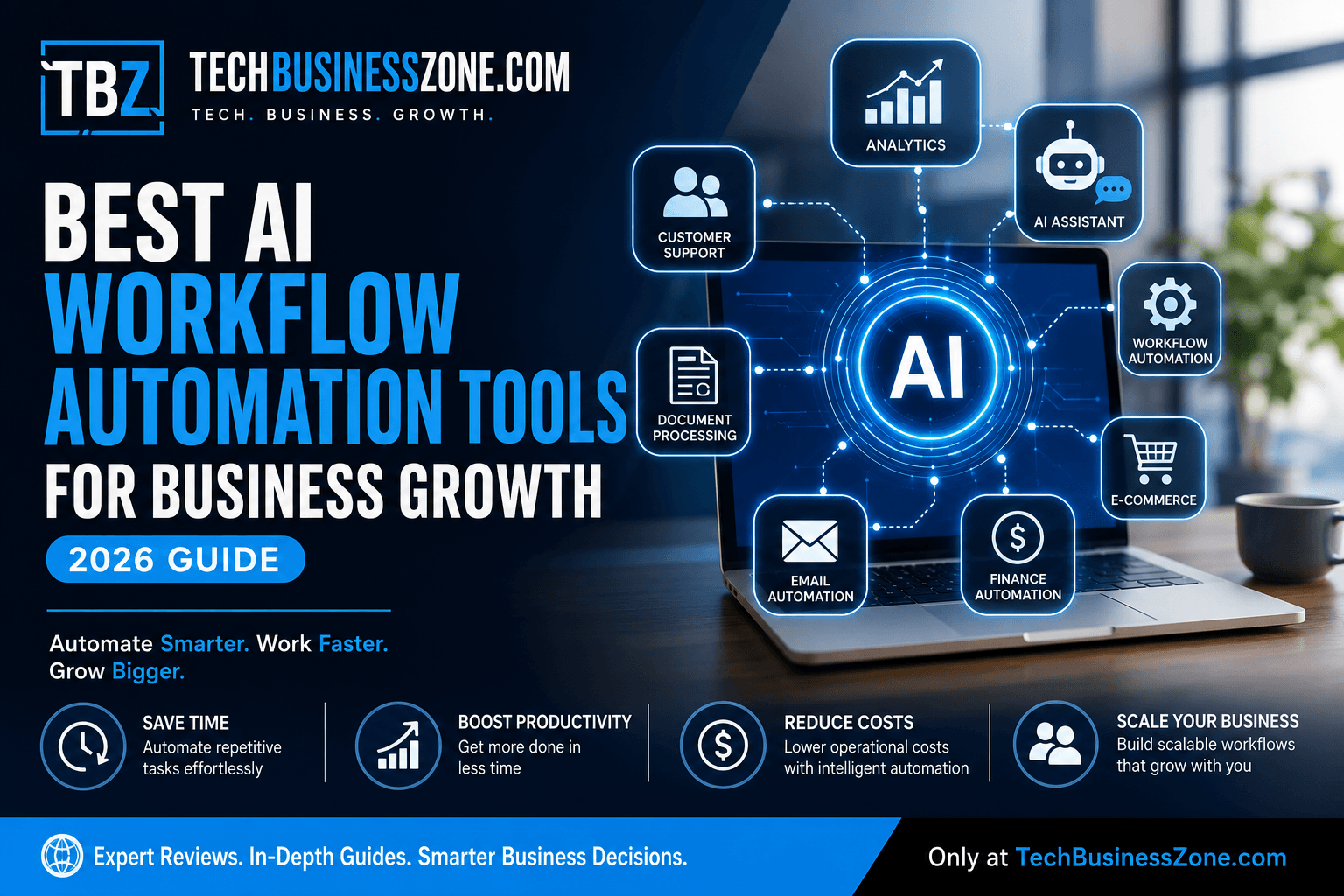
Best AI Workflow Automation Tools for Business Growth (2026 Guide)
Introduction
Many business owners still believe Best AI Workflow Automation Tools for Business Growth (2026 Guide) workflow automation tools require complex programming, expensive developers, or enterprise-level IT teams. That assumption is no longer true. In 2026, AI workflow automation has become more accessible than ever, allowing startups, small businesses, and large enterprises to automate repetitive tasks with little or no coding.
Modern AI-powered automation tools go beyond simple rule-based workflows. They can analyze data, make intelligent decisions, summarize information, classify documents, generate content, and even recommend the next best action. As a result, businesses save countless hours, reduce human error, improve collaboration, and make faster decisions across departments.
This guide compares the best AI workflow automation tools available in 2026, explains how intelligent workflow automation works, and helps you choose the right solution based on your business size and goals. You’ll also learn implementation strategies, pricing considerations, key features to prioritize, and best practices that maximize your return on investment.
Whether you’re running a startup, managing a growing business, or leading digital transformation in an enterprise, this guide will help you understand how AI workflow automation can accelerate business growth.
Direct Answer: What Are the Best AI Workflow Automation Tools for Business Growth?
Businesses looking to improve productivity, eliminate repetitive tasks, and scale operations should invest in AI workflow automation platforms. Unlike traditional automation, which only follows predefined rules, AI-powered workflow automation uses technologies such as machine learning, natural language processing (NLP), predictive analytics, and intelligent decision-making to automate both routine and complex business processes.
Some of the leading AI business automation tools in 2026 include Zapier AI, Microsoft Power Automate, Make, UiPath, Workato, Airtable AI, ClickUp AI, Notion AI, Monday.com AI, and HubSpot AI Automation. Each platform serves different business needs depending on company size, technical expertise, and automation complexity.
For startups and small businesses, Zapier AI and Make offer affordable no-code AI automation platforms with hundreds of integrations. Growing companies often benefit from Microsoft Power Automate and HubSpot AI because of their strong Microsoft and CRM ecosystems. Large enterprises usually prefer UiPath and Workato due to their advanced security, governance, and enterprise-grade scalability.
Quick Takeaways
- AI workflow automation combines artificial intelligence with business process automation.
- It automates repetitive work while making intelligent decisions.
- No-code platforms allow non-technical users to build automated workflows.
- AI-powered workflow management improves efficiency, reduces operational costs, and enhances customer experiences.
- Selecting the right platform depends on workflow complexity, integration requirements, security needs, and future growth plans.
What Is AI Workflow Automation?
AI is transforming how organizations manage daily operations. Instead of employees manually completing repetitive tasks, businesses can use intelligent systems that learn from data, adapt to changing conditions, and continuously optimize workflows. This shift enables companies to operate faster while improving accuracy and customer satisfaction.
Definition of AI Workflow Automation
AI workflow automation refers to the use of artificial intelligence technologies to automate business processes that traditionally required human intervention. Unlike basic automation, AI systems can interpret information, recognize patterns, make predictions, and execute decisions with minimal supervision.
Examples include:
- Automatically routing customer support tickets
- Processing invoices without manual data entry
- Qualifying sales leads using AI
- Generating reports from multiple data sources
- Approving purchase requests based on predefined business logic
By combining automation with intelligence, organizations create more adaptive and efficient business operations.
How AI-Powered Automation Works
AI-powered automation combines several technologies to execute workflows more intelligently than traditional systems.
Machine learning analyzes historical business data to identify trends and improve future decisions. Natural language processing understands emails, documents, and customer conversations. Computer vision extracts information from scanned documents and images. Predictive analytics forecasts business outcomes, while automation engines execute tasks across connected software platforms.
For example, when a customer submits an online inquiry, an AI automation platform can identify the request, determine its priority, assign it to the appropriate team, generate a personalized response, update the CRM, and notify management—all without manual intervention.
Difference Between Traditional Automation and AI Automation
Traditional automation follows fixed rules.
For example:
“If invoice amount exceeds $5,000, send it to the finance manager.”
AI automation goes much further.
Instead of relying solely on predefined conditions, AI evaluates multiple factors such as purchasing history, vendor behavior, approval trends, and financial risk before making recommendations.
Traditional automation is excellent for repetitive, predictable tasks. AI automation is designed for dynamic processes where data changes frequently, and decisions require contextual understanding.
This makes AI process automation software significantly more valuable for organizations handling large volumes of data or complex business workflows.
Benefits for Modern Businesses
Organizations implementing AI workflow automation experience measurable improvements across multiple departments.
Key benefits include:
- Reduced manual workload
- Faster business processes
- Higher employee productivity
- Improved decision-making
- Better customer experiences
- Fewer operational errors
- Lower administrative costs
- Increased scalability
- Better compliance and reporting
- More time for strategic work
As AI continues to evolve, businesses gain competitive advantages by automating repetitive activities while allowing employees to focus on innovation and growth.
Why Businesses Are Investing in AI Automation in 2026
Artificial intelligence is no longer viewed as an experimental technology. It has become a practical business investment that delivers measurable returns across operations, customer service, finance, marketing, and human resources. Organizations of every size are recognizing that intelligent workflow automation helps them accomplish more with fewer resources while improving service quality and operational efficiency.
Increased Productivity
One of the biggest reasons companies adopt AI workflow automation is productivity improvement.
Employees spend a significant portion of their day performing repetitive administrative work such as copying data, updating spreadsheets, generating reports, responding to routine emails, or transferring information between applications.
AI automation handles these repetitive processes automatically, allowing employees to focus on creative problem-solving, customer relationships, strategic planning, and business development.
Many organizations report productivity improvements of 30–60% after implementing intelligent workflow automation across key business functions.
Reduced Operational Costs
Manual business processes are expensive.
Every repetitive task consumes employee time, increases labor costs, and introduces opportunities for human error.
By automating repetitive workflows, businesses reduce administrative overhead, minimize costly mistakes, and improve overall resource utilization.
Although implementing AI automation requires an initial investment, many companies recover those costs through labor savings, improved operational efficiency, and increased productivity within the first year.
Better Customer Experience
Customers expect immediate responses and personalized service.
AI workflow automation enables businesses to deliver faster support by automatically routing requests, answering common questions, updating customer records, and escalating complex cases to human agents when necessary.
This creates shorter response times, higher customer satisfaction, and more consistent service across every communication channel.
Additionally, AI analyzes customer behavior to personalize recommendations, helping businesses strengthen long-term customer relationships.
Faster Decision Making
Business leaders rely on timely information to make effective decisions.
AI-powered workflow management continuously gathers data from multiple systems, analyzes trends, identifies anomalies, and generates actionable insights in real time.
Instead of waiting days for reports, managers receive instant dashboards and intelligent recommendations that support quicker, more informed decision-making.
This speed allows businesses to respond rapidly to market changes, customer demands, and operational challenges.
Improved Employee Efficiency
Automation does not replace employees—it enhances their capabilities.
When repetitive tasks are automated, employees can dedicate more time to innovation, collaboration, strategic planning, and customer engagement.
AI also reduces burnout by eliminating tedious administrative work, improving job satisfaction while helping teams accomplish more without increasing headcount.
Organizations that combine employee expertise with AI assistance often experience stronger performance and greater workforce engagement.
Scalable Business Operations
As businesses grow, manual workflows become increasingly difficult to manage.
Hiring additional employees for every operational increase is rarely sustainable. AI workflow automation enables organizations to scale efficiently by handling higher workloads without proportional increases in staffing.
Whether processing thousands of customer inquiries, managing complex financial approvals, or coordinating global supply chains, AI automation provides the flexibility needed to support long-term business growth.
Companies that invest in scalable automation today are better prepared to adapt to future market demands while maintaining consistent performance and operational excellence.
How AI Workflow Automation Works
Behind every successful automation platform is a combination of artificial intelligence technologies working together. Instead of simply following fixed rules, modern AI workflow automation solutions can learn from data, understand language, predict outcomes, and connect multiple business applications seamlessly. These capabilities enable organizations to automate increasingly complex workflows while improving accuracy and efficiency.
Machine Learning
Machine learning is the foundation of intelligent automation. It enables software to analyze historical data, identify patterns, and continuously improve its performance without requiring manual programming updates.
For example, an AI-powered sales workflow can learn which leads are most likely to convert based on previous customer behavior. Over time, the system becomes more accurate at prioritizing high-value prospects, helping sales teams focus their efforts where they matter most.
Machine learning is commonly used for:
- Customer segmentation
- Fraud detection
- Sales forecasting
- Inventory optimization
- Demand prediction
- Personalized recommendations
As businesses collect more operational data, machine learning models become increasingly effective, making AI business automation tools smarter over time.
Natural Language Processing (NLP)
Natural Language Processing (NLP) allows AI systems to understand, interpret, and generate human language.
Instead of requiring structured inputs, NLP enables automation platforms to process emails, chat messages, support tickets, contracts, and customer feedback.
Common business applications include:
- AI chatbots
- Email categorization
- Customer sentiment analysis
- Automated document summaries
- Intelligent ticket routing
- Meeting transcription
For customer support teams, NLP dramatically reduces response times by automatically understanding customer intent and routing inquiries to the correct department.
Intelligent Document Processing
Many organizations still rely heavily on invoices, purchase orders, contracts, receipts, and application forms.
Intelligent Document Processing (IDP) uses optical character recognition (OCR), machine learning, and AI to extract relevant information from both digital and scanned documents.
Instead of manually entering data into accounting or ERP systems, businesses can automate document processing with significantly higher accuracy.
Typical use cases include:
- Invoice processing
- HR onboarding documents
- Insurance claims
- Medical records
- Legal contracts
- Vendor documentation
This technology eliminates repetitive data entry while reducing costly human errors.
Predictive Analytics
Predictive analytics helps organizations anticipate future outcomes using historical and real-time business data.
Rather than reacting to events after they occur, businesses can proactively plan for changing market conditions.
Examples include:
- Predicting customer churn
- Forecasting product demand
- Identifying equipment maintenance needs
- Estimating project completion dates
- Detecting financial risks
When integrated into AI-powered workflow management, predictive analytics enables businesses to make faster, more informed decisions while reducing uncertainty.
AI Decision Engines
Decision engines take automation beyond simple if-then logic.
These systems evaluate multiple business variables simultaneously before recommending or executing the best possible action.
For example, an AI approval workflow may consider:
- Budget availability
- Purchase history
- Vendor reliability
- Department spending limits
- Compliance requirements
- Risk scores
Instead of requiring multiple managers to manually review every request, AI automatically handles routine decisions while escalating only exceptions that require human oversight.
API-Based Integrations
Modern businesses use dozens of software platforms every day, including CRM systems, accounting software, HR platforms, project management tools, communication apps, and ecommerce solutions.
API-based integrations allow these systems to exchange information automatically without manual intervention.
For example:
- New website leads automatically appear in the CRM.
- Closed sales generate invoices in accounting software.
- HR approvals trigger employee onboarding workflows.
- Customer purchases update inventory levels instantly.
Strong API connectivity is one of the most important features of modern AI workflow automation, allowing businesses to create a connected digital ecosystem where information flows seamlessly between applications.
Best AI Workflow Automation Tools for Business Growth
The market for intelligent workflow automation has expanded significantly, giving businesses more options than ever before. The ideal platform depends on your company’s size, technical expertise, integration requirements, and workflow complexity. Below are some of the leading AI business automation tools that consistently deliver excellent performance in 2026.
Zapier AI
Zapier AI is one of the most beginner-friendly no-code automation platforms available.
It connects more than 8,000 applications and enables businesses to build automated workflows without programming knowledge. AI features include workflow suggestions, content generation, intelligent filtering, and natural language automation creation.
Best for:
- Small businesses
- Entrepreneurs
- Marketing teams
- Customer support
- Simple workflow automation
Microsoft Power Automate
Microsoft Power Automate is designed for organizations already using the Microsoft ecosystem.
Its AI Builder allows businesses to automate document processing, approvals, customer communications, and enterprise workflows while integrating seamlessly with Microsoft 365, Dynamics 365, Teams, and Azure.
Best for:
- Medium-sized businesses
- Enterprises
- Microsoft environments
- Finance departments
Make (Formerly Integromat)
Make provides a highly visual workflow builder that offers greater flexibility than many entry-level automation platforms.
Its drag-and-drop interface makes it easy to create advanced multi-step workflows involving hundreds of connected applications.
Best for:
- Agencies
- Ecommerce businesses
- Marketing automation
- Complex integrations
UiPath
UiPath is a leading enterprise robotic process automation (RPA) platform enhanced with artificial intelligence.
It automates repetitive desktop processes, enterprise workflows, document processing, and customer service operations while supporting advanced governance and compliance requirements.
Best for:
- Large enterprises
- Banking
- Healthcare
- Manufacturing
- Government organizations
Workato
Workato combines enterprise integration with powerful AI capabilities.
Businesses use it to automate finance, HR, sales, marketing, procurement, and customer operations while maintaining enterprise-grade security.
Its extensive automation recipes help organizations deploy workflows quickly.
Best for:
- Growing enterprises
- Digital transformation projects
- Large-scale automation
HubSpot AI Automation
HubSpot AI extends CRM automation with intelligent marketing, sales, and customer service capabilities.
Businesses can automate lead nurturing, email personalization, customer segmentation, ticket routing, and reporting from one unified platform.
Best for:
- Marketing teams
- Sales organizations
- Customer success teams
- Growing startups
Airtable AI
Airtable AI combines the flexibility of spreadsheets with database functionality and artificial intelligence.
Organizations use it to automate project management, content planning, product development, and operational workflows.
Best for:
- Operations teams
- Product management
- Creative agencies
- Content marketing
Notion AI
Notion AI enhances workplace productivity by automating documentation, meeting notes, task management, research, and knowledge sharing.
Teams can quickly summarize lengthy documents, generate content, and organize information within collaborative workspaces.
Best for:
- Knowledge workers
- Startups
- Remote teams
- Documentation management
ClickUp AI
ClickUp AI integrates project management with intelligent productivity features.
Its AI assistant helps generate project plans, summarize discussions, create documentation, and automate recurring administrative tasks.
Best for:
- Project managers
- Marketing teams
- Software development
- Business operations
Monday.com AI
Monday.com AI introduces intelligent automation into project management and business operations.
Businesses can automate approvals, assign tasks, generate project summaries, and improve collaboration across departments.
Best for:
- Cross-functional teams
- Project management
- Operations
- Professional services
n8n
n8n is a source-available automation platform popular among developers and technically inclined businesses.
It provides exceptional flexibility, custom coding options, AI integrations, and self-hosting capabilities for organizations requiring complete control over their automation environment.
Best for:
- Developers
- Technical startups
- Custom integrations
- Self-hosted deployments
Pipedream
Pipedream focuses on developer-centric workflow automation with serverless execution and API orchestration.
It allows businesses to automate complex backend processes while integrating AI models, databases, webhooks, and cloud services.
Best for:
- SaaS companies
- Software developers
- API automation
- Custom business applications
Comparison Table of the Best AI Workflow Automation Platforms
| Tool | Best For | AI Features | Ease of Use | Integrations | Pricing | Scalability |
|---|---|---|---|---|---|---|
| Zapier AI | Small businesses | AI workflow suggestions, content generation | Very Easy | 8,000+ | $$ | Medium |
| Microsoft Power Automate | Microsoft users | AI Builder, document automation | Easy | Excellent | $$ | High |
| Make | Advanced workflows | AI integrations, visual builder | Moderate | Extensive | $$ | High |
| UiPath | Enterprises | RPA, OCR, AI models | Advanced | Enterprise-grade | $$$$ | Enterprise |
| Workato | Large organizations | Enterprise AI automation | Moderate | Extensive | $$$$ | Enterprise |
| HubSpot AI | Marketing & Sales | CRM AI, lead automation | Easy | Excellent | $$$ | High |
| Airtable AI | Operations | AI data organization | Easy | Good | $$ | High |
| Notion AI | Documentation | AI writing, summaries | Very Easy | Moderate | $$ | Medium |
| ClickUp AI | Project management | AI productivity assistant | Easy | Good | $$ | High |
| Monday.com AI | Team collaboration | AI task automation | Easy | Good | $$$ | High |
| n8n | Developers | AI workflows, self-hosting | Advanced | Excellent | Free/Paid | Enterprise |
| Pipedream | API automation | AI APIs, serverless workflows | Advanced | Extensive | Usage-based | Enterprise |
Best AI Automation Tool by Business Type
Every organization has unique workflow requirements, budgets, and technical capabilities. Choosing the right platform ensures your automation strategy delivers long-term value while supporting future growth. Matching the software to your business model often produces better results than simply selecting the platform with the most features.
Small Businesses
Recommended: Zapier AI
Its affordability, ease of use, and extensive integrations make it ideal for businesses beginning their automation journey.
Startups
Recommended: Make or n8n
Startups benefit from flexible automation, rapid deployment, and scalability without significant infrastructure investments.
Marketing Agencies
Recommended: HubSpot AI or ClickUp AI
These platforms automate campaign management, client communication, reporting, content workflows, and CRM activities.
Ecommerce Stores
Recommended: Make or Zapier AI
They automate inventory synchronization, order processing, abandoned cart recovery, customer notifications, and shipping updates.
SaaS Companies
Recommended: Pipedream or n8n
Developer-focused automation platforms provide powerful API orchestration, webhook management, and backend automation.
Healthcare Organizations
Recommended: UiPath
Healthcare providers benefit from secure document processing, patient onboarding automation, and regulatory compliance capabilities.
Financial Services
Recommended: Microsoft Power Automate or UiPath
Both platforms support secure approvals, compliance monitoring, invoice processing, and financial reporting automation.
Enterprise Businesses
Recommended: Workato or UiPath
Large organizations require enterprise-grade governance, security, scalability, and advanced integration capabilities that these platforms provide.
Essential Features to Look for in AI Workflow Automation Software
Not every automation platform offers the same capabilities. Before investing, evaluate features that directly support your operational goals, security requirements, and future scalability. Selecting software with the right foundation ensures your automation ecosystem continues delivering value as your business evolves.
No-Code Workflow Builder
Visual drag-and-drop builders allow non-technical employees to design workflows quickly without writing code.
AI Assistant
An intelligent assistant can recommend automations, generate workflows, summarize information, and improve productivity.
Hundreds of Integrations
Choose platforms that connect seamlessly with CRM systems, accounting software, marketing platforms, cloud storage, communication tools, and databases.
Custom API Support
Custom APIs enable organizations to integrate proprietary systems and specialized applications beyond standard connectors.
Security and Compliance
Look for role-based permissions, encryption, audit logs, compliance certifications, and identity management features to protect sensitive business information.
Analytics Dashboard
Comprehensive dashboards provide visibility into workflow performance, execution history, processing time, bottlenecks, and overall return on investment.
Workflow Templates
Pre-built templates reduce implementation time and help businesses automate common processes without starting from scratch.
Error Handling
Reliable automation platforms include retry mechanisms, notifications, exception handling, and detailed logs to minimize workflow failures.
Team Collaboration
Collaboration features allow departments to build, review, manage, and optimize automated workflows together while maintaining version control and governance.
Real Business Use Cases of AI Workflow Automation
AI is no longer limited to large enterprises with dedicated IT teams. Today, organizations of every size are using AI workflow automation to streamline operations, reduce manual effort, and improve decision-making. From sales and marketing to finance and IT, intelligent automation is transforming how businesses operate and compete in increasingly fast-paced markets.
Sales Automation
Sales teams spend a significant amount of time on administrative tasks instead of building customer relationships. AI-powered workflow management automates repetitive activities, allowing sales professionals to focus on closing deals.
Common sales automation tasks include:
- Lead assignment
- CRM updates
- Meeting scheduling
- Follow-up emails
- Proposal generation
- Sales forecasting
AI can also score leads based on customer behavior, ensuring sales representatives prioritize prospects with the highest conversion potential.
Marketing Automation
Marketing departments manage multiple campaigns across email, social media, websites, and advertising platforms.
AI business automation tools simplify campaign management by automating:
- Email marketing
- Social media publishing
- Audience segmentation
- Personalized recommendations
- Content scheduling
- Campaign reporting
AI also analyzes campaign performance and recommends optimizations that improve engagement and return on investment.
Customer Support Automation
Customer expectations continue to rise, making fast responses essential.
AI-powered support systems automate:
- Chatbots
- Ticket routing
- FAQ responses
- Customer sentiment analysis
- Knowledge base recommendations
- Escalation workflows
Support agents spend less time answering repetitive questions while customers receive quicker, more consistent assistance.
HR Recruitment
Recruiting involves reviewing resumes, scheduling interviews, communicating with candidates, and maintaining applicant records.
AI automation accelerates hiring by:
- Screening resumes
- Ranking candidates
- Scheduling interviews
- Sending automated updates
- Managing recruitment pipelines
Recruiters can focus more on evaluating talent rather than handling repetitive administrative work.
Employee Onboarding
The onboarding process often involves numerous manual tasks spread across multiple departments.
With AI workflow automation, organizations can automatically:
- Create employee accounts
- Assign equipment
- Send training materials
- Schedule orientation sessions
- Collect required documents
- Track onboarding progress
This creates a smoother experience for new employees while reducing administrative workload.
Finance Automation
Finance departments handle highly repetitive and data-intensive processes every day.
AI helps automate:
- Budget approvals
- Expense management
- Financial reporting
- Bank reconciliation
- Payment approvals
- Audit preparation
Automation improves accuracy while reducing processing times and compliance risks.
Invoice Processing
Invoice management is one of the most common automation use cases.
Using intelligent document processing, AI extracts invoice information, validates purchase orders, routes approvals, and updates accounting systems automatically.
Benefits include:
- Faster approvals
- Reduced manual data entry
- Fewer processing errors
- Better cash flow visibility
- Improved supplier relationships
Lead Management
Businesses generate leads from websites, social media, advertisements, webinars, and referrals.
AI automatically:
- Captures leads
- Scores lead quality
- Assigns prospects
- Triggers nurturing campaigns
- Updates CRM records
- Alerts sales representatives
This ensures valuable opportunities are never overlooked.
Inventory Management
Inventory accuracy directly impacts customer satisfaction and profitability.
AI predicts product demand, monitors stock levels, automates purchase orders, and identifies slow-moving inventory before shortages or excess stock become costly.
Retailers and manufacturers particularly benefit from intelligent inventory forecasting.
IT Operations
IT departments rely heavily on automation to improve operational efficiency.
Common use cases include:
- User account provisioning
- Password resets
- Software deployment
- System monitoring
- Incident management
- Backup scheduling
By automating routine maintenance tasks, IT teams can focus on strategic technology initiatives rather than repetitive support requests.
Step-by-Step Guide to Implementing AI Workflow Automation
Successful automation projects begin with careful planning rather than technology selection alone. Businesses that clearly define objectives, involve stakeholders, and continuously optimize their workflows typically achieve much higher returns. Following a structured implementation process minimizes disruption while maximizing the long-term value of AI workflow automation.
Identify Repetitive Processes
Start by identifying tasks that consume significant employee time and follow consistent, repeatable steps.
Look for activities such as:
- Data entry
- Report generation
- Email responses
- Document approvals
- Customer notifications
- CRM updates
These repetitive processes usually offer the quickest automation wins.
Set Automation Goals
Clearly define what success looks like before implementing automation.
Common objectives include:
- Reduce manual work
- Improve customer response times
- Increase productivity
- Lower operational costs
- Improve data accuracy
- Accelerate business growth
Specific, measurable goals make it easier to evaluate your project’s success.
Choose the Right Platform
Select a platform based on your organization’s:
- Business size
- Technical expertise
- Budget
- Integration requirements
- Security needs
- Scalability expectations
The best platform is one that supports both your current requirements and future growth.
Design Your Workflow
Map every step of the process before automating it.
Identify:
- Trigger events
- Decision points
- Data sources
- Notifications
- Approval stages
- Expected outputs
Well-designed workflows reduce future maintenance while improving reliability.
Test the Automation
Always test workflows thoroughly before deployment.
Verify that:
- Integrations function correctly
- Notifications are delivered
- Data transfers accurately
- Exceptions are handled properly
- Security permissions work as expected
Testing helps identify issues before they affect daily operations.
Monitor Performance
Implementation is only the beginning.
Track key performance indicators such as:
- Workflow completion times
- Error rates
- Employee time savings
- Cost reductions
- Customer satisfaction
- Automation success rates
Continuous monitoring ensures workflows continue delivering business value.
Optimize Using AI Insights
One advantage of modern AI-powered workflow management is continuous improvement.
AI analyzes workflow performance, identifies bottlenecks, recommends optimizations, and highlights opportunities for additional automation.
Businesses that regularly refine their workflows often achieve significantly greater productivity gains over time.
Personal Experience: Lessons Learned from Implementing AI Workflow Automation
After working on several automation initiatives across different business functions, one lesson became clear: successful automation depends far more on process design than software selection. While modern platforms are incredibly capable, the greatest improvements come from understanding existing workflows, involving employees early, and continuously refining automated processes based on real operational data.
Starting with One Department
One of the smartest decisions was beginning with a single department instead of attempting a company-wide rollout.
Starting with customer support allowed the team to test workflows, identify challenges, and build confidence before expanding automation into sales, HR, and finance.
This phased approach reduced risk while delivering measurable improvements quickly.
Unexpected Workflow Bottlenecks
Some automation projects initially failed because inefficient manual processes were simply automated without first improving them.
For example, approval workflows containing unnecessary review stages remained slow even after automation.
Redesigning the business process before automating it produced far better results than automating inefficient workflows.
Importance of Employee Training
Technology adoption depends heavily on user confidence.
Providing hands-on training sessions, clear documentation, and ongoing support significantly improved employee adoption rates.
When employees understood that AI business automation tools were designed to eliminate repetitive work—not replace their expertise—they became enthusiastic supporters of the initiative.
Measuring Productivity Improvements
Rather than relying on assumptions, performance was tracked using measurable metrics.
Key indicators included:
- Hours saved each week
- Workflow completion times
- Error reduction
- Customer response speed
- Employee satisfaction
- Operational costs
Within several months, repetitive administrative work had decreased substantially while overall productivity improved across multiple departments.
Continuous Workflow Optimization
Automation should never be considered a one-time project.
As business requirements changed, workflows required regular updates to accommodate new software integrations, revised approval policies, and evolving customer expectations.
Continuous optimization ensured the automation environment remained efficient, scalable, and aligned with business objectives.
Common Mistakes Businesses Make
Although automation offers tremendous benefits, many organizations fail to achieve expected results because they overlook fundamental planning and governance principles. Avoiding these common mistakes significantly increases the likelihood of a successful AI workflow automation implementation.
Automating Poor Processes
Automation cannot fix an inefficient process.
Before implementing AI, simplify unnecessary approval steps, remove duplicate activities, and eliminate outdated procedures.
A streamlined workflow always performs better than an automated inefficient one.
Ignoring Data Quality
Artificial intelligence depends on accurate information.
Incomplete customer records, duplicate entries, inconsistent formatting, and outdated databases reduce automation accuracy and decision quality.
Maintaining clean, reliable data should be a top priority.
Choosing the Wrong Automation Tool
Not every platform fits every business.
Selecting software based solely on popularity instead of integration capabilities, scalability, or business requirements often leads to disappointing outcomes.
Evaluate long-term needs before investing.
Lack of Employee Adoption
Employees should be included throughout the automation journey.
Ignoring user feedback often results in resistance, low adoption, and underutilized automation capabilities.
Clear communication and practical training encourage stronger engagement.
No Performance Monitoring
Without monitoring, businesses cannot determine whether automation is delivering value.
Regularly review workflow performance, identify bottlenecks, and measure key business metrics to ensure continuous improvement.
Weak Security Controls
Automation platforms frequently process sensitive customer, employee, and financial information.
Weak access controls, poor authentication practices, and unsecured integrations increase cybersecurity risks.
Security should be incorporated into every stage of automation planning.
AI Workflow Automation Security Best Practices
As organizations automate more business-critical processes, protecting sensitive information becomes increasingly important. Strong governance and security controls ensure AI workflow automation improves efficiency without exposing the business to unnecessary cybersecurity, compliance, or operational risks.
Role-Based Access Control
Grant employees access only to the workflows and data necessary for their responsibilities.
Role-based permissions reduce unauthorized access while simplifying compliance management.
Multi-Factor Authentication
Enable multi-factor authentication (MFA) for all administrator and privileged accounts.
MFA significantly reduces the risk of compromised credentials leading to unauthorized system access.
Data Encryption
Protect sensitive business information using encryption during both storage and transmission.
Encryption safeguards customer records, financial documents, employee information, and confidential business data from unauthorized access.
API Security
Since automation platforms rely heavily on APIs, secure every integration by:
- Using authenticated API keys
- Rotating credentials regularly
- Applying rate limits
- Monitoring API activity
- Restricting unnecessary permissions
Strong API security protects connected business applications from potential attacks.
Compliance Requirements
Organizations operating in regulated industries should ensure automation platforms support applicable compliance standards such as GDPR, HIPAA, SOC 2, ISO 27001, or industry-specific regulations.
Compliance should be considered during platform selection—not after implementation.
Regular Workflow Audits
Automation environments continuously evolve as new workflows are added and existing ones change.
Conduct periodic audits to review:
- User permissions
- Workflow accuracy
- Integration security
- Failed automations
- Compliance status
- Performance metrics
Routine reviews help identify vulnerabilities early while ensuring automated business processes remain secure, efficient, and aligned with organizational objectives.
Pricing Comparison of Leading AI Automation Platforms
Pricing is one of the most important considerations when selecting an AI workflow automation platform. While many providers offer free plans for individuals or small teams, enterprise deployments typically include advanced AI capabilities, enhanced security, governance, and premium support. The best choice depends on your workflow complexity, integration needs, and expected business growth.
| Platform | Free Plan | Starting Price* | Enterprise Option | Best Value |
|---|---|---|---|---|
| Zapier AI | Yes | From $20/month | Yes | Small businesses |
| Microsoft Power Automate | Yes (limited) | From $15/user/month | Yes | Microsoft ecosystem |
| Make | Yes | From $10.59/month | Yes | Growing businesses |
| UiPath | Community Edition | Custom pricing | Yes | Large enterprises |
| Workato | No | Custom pricing | Yes | Enterprise automation |
| HubSpot AI | Limited | From $20/month (varies by Hub) | Yes | Marketing & sales teams |
| Airtable AI | Limited | From $20/user/month | Yes | Operations teams |
| Notion AI | No (AI add-on) | AI add-on pricing | Yes | Documentation & collaboration |
| ClickUp AI | Limited | AI add-on pricing | Yes | Project management |
| Monday.com AI | Limited | From $12/user/month | Yes | Team collaboration |
| n8n | Yes | Self-hosted or cloud plans | Yes | Developers & custom workflows |
| Pipedream | Yes | Usage-based pricing | Yes | API-driven automation |
*Pricing may change over time, so always verify the latest plans before making a purchasing decision.
ROI Analysis: Is AI Workflow Automation Worth the Investment?
Most organizations initially evaluate automation based on software subscription costs. However, the real value comes from time savings, improved productivity, reduced operational expenses, and better customer experiences. When implemented strategically, AI workflow automation often delivers a strong return on investment within the first year, especially for businesses that automate repetitive, high-volume processes.
Cost Savings
One of the most immediate benefits of automation is lower operating costs.
Businesses reduce expenses by:
- Eliminating repetitive manual work
- Reducing overtime
- Minimizing processing errors
- Lowering administrative costs
- Improving resource utilization
Instead of hiring additional staff to handle increasing workloads, organizations can scale operations more efficiently using AI business automation tools.
Productivity Gains
Automation enables employees to complete more work in less time.
Rather than spending hours entering data or updating spreadsheets, teams focus on activities that generate business value, including customer engagement, innovation, and strategic planning.
Organizations often experience noticeable productivity improvements after automating repetitive workflows across multiple departments.
Employee Time Saved
Time is one of the most valuable business resources.
AI automation can save employees several hours each week by automating tasks such as:
- Data entry
- Report generation
- Meeting scheduling
- Email routing
- CRM updates
- Document approvals
These time savings compound across departments, resulting in significant operational efficiency.
Revenue Growth
Automation contributes directly to revenue by helping businesses serve customers faster and respond to opportunities more effectively.
Examples include:
- Faster sales follow-ups
- Improved lead nurturing
- Reduced customer churn
- Increased order processing capacity
- Better marketing performance
More efficient operations create greater capacity for business growth without proportionally increasing staffing costs.
Customer Satisfaction Improvements
Customers appreciate speed, consistency, and personalized service.
AI-powered workflow management helps businesses respond faster, reduce mistakes, and deliver more reliable customer experiences.
Satisfied customers are more likely to remain loyal, recommend the business, and generate repeat revenue.
Long-Term Business Value
Beyond immediate productivity gains, automation creates a stronger operational foundation.
Businesses become:
- More scalable
- More resilient
- Better prepared for growth
- More competitive
- Better positioned for digital transformation
The long-term value often exceeds the initial implementation cost, particularly for organizations committed to continuous workflow optimization.
Advanced Edge Cases and Troubleshooting
As automation initiatives expand across multiple departments and software platforms, businesses encounter increasingly complex technical challenges. Successfully managing these scenarios requires careful planning, ongoing monitoring, and strong governance. Addressing these edge cases early helps maintain reliable AI workflow automation while minimizing operational disruptions.
Managing API Rate Limits Across Multiple Applications
Many cloud applications limit the number of API requests allowed within a specific time period.
To avoid service interruptions:
- Batch requests where possible
- Implement retry logic
- Cache frequently accessed data
- Monitor API usage
- Distribute requests intelligently
These practices reduce failures caused by exceeded rate limits.
Handling Workflow Failures and Automatic Recovery
No automation system is completely immune to unexpected failures.
Build resilient workflows that include:
- Automatic retries
- Error notifications
- Backup processing paths
- Failure logging
- Manual approval fallbacks
Recovery mechanisms reduce downtime while protecting critical business operations.
Preventing Duplicate Automation Triggers
Duplicate workflow executions may create multiple invoices, duplicate customer records, or repeated notifications.
Prevent this by:
- Using unique transaction IDs
- Tracking completed workflows
- Implementing conditional logic
- Validating incoming data before execution
Careful workflow design minimizes duplicate processing.
Synchronizing Data Between Legacy Systems and AI Platforms
Many organizations continue using older ERP, accounting, or database systems.
Successful synchronization requires:
- Data mapping
- Format standardization
- Scheduled synchronization
- Conflict resolution rules
- Continuous validation
Reliable integration ensures consistent information across modern AI platforms and legacy infrastructure.
Scaling AI Automation for Thousands of Daily Transactions
As businesses grow, workflows must process increasing transaction volumes without performance degradation.
Scalability strategies include:
- Distributed processing
- Queue management
- Parallel execution
- Cloud-based infrastructure
- Load balancing
These techniques help maintain consistent workflow performance during peak demand.
Securing Sensitive Customer Data During Automated Processes
Automation frequently handles confidential customer and financial information.
Protect sensitive data by:
- Encrypting information
- Restricting permissions
- Masking confidential fields
- Monitoring access logs
- Following least-privilege principles
Strong security practices reduce cybersecurity risks while maintaining regulatory compliance.
Debugging Multi-Step Workflow Errors
Complex workflows often involve numerous applications, APIs, and decision points.
Effective troubleshooting includes:
- Reviewing execution logs
- Testing individual workflow stages
- Validating input data
- Monitoring API responses
- Tracking processing times
Detailed logging significantly simplifies problem identification.
Optimizing AI Costs for High-Volume Operations
AI-powered features often charge based on usage.
Businesses can reduce costs by:
- Automating only valuable processes
- Eliminating unnecessary AI requests
- Reusing processed data
- Scheduling non-urgent workloads during lower-demand periods
- Monitoring AI consumption regularly
Cost optimization becomes increasingly important as automation scales.
Managing AI Hallucinations in Business Workflows
Generative AI occasionally produces inaccurate or fabricated information.
Reduce this risk by:
- Validating AI-generated outputs
- Using human approvals for critical decisions
- Limiting AI autonomy in regulated processes
- Providing structured prompts
- Monitoring response quality
Human oversight remains essential for business-critical workflows.
Maintaining Compliance Across Global Operations
International organizations must comply with multiple privacy and regulatory frameworks.
Automation platforms should support:
- Regional data storage
- Audit logging
- Consent management
- Data retention policies
- Industry-specific compliance standards
Compliance should be built into workflow design from the beginning rather than added later.
Future Trends in AI Workflow Automation
Artificial intelligence continues evolving at an extraordinary pace. Over the next several years, AI workflow automation will become more intelligent, autonomous, and deeply integrated into everyday business operations. Organizations that stay ahead of these trends will gain significant competitive advantages.
Autonomous AI Agents
AI agents are beginning to perform complete business tasks independently rather than simply assisting users.
Future systems will:
- Coordinate projects
- Communicate with customers
- Execute business processes
- Make routine operational decisions
- Collaborate with other AI agents
Generative AI in Business Operations
Generative AI will continue expanding beyond content creation.
Businesses will increasingly use it for:
- Proposal generation
- Report writing
- Knowledge management
- Customer communication
- Workflow documentation
Hyperautomation
Hyperautomation combines robotic process automation, machine learning, AI, analytics, and business process management into one intelligent ecosystem.
Rather than automating isolated tasks, organizations will automate complete end-to-end business operations.
AI Process Mining
Process mining software analyzes operational data to identify inefficiencies automatically.
Businesses will increasingly rely on AI to recommend workflow improvements before problems affect productivity.
Voice-Controlled Workflows
Voice interfaces will simplify automation management.
Managers may soon approve purchases, request reports, launch workflows, or monitor operations using natural voice commands.
AI-Powered Decision Intelligence
Future automation platforms will provide increasingly sophisticated business recommendations based on predictive analytics, historical performance, and real-time operational data.
Decision intelligence will support executives with faster, more accurate strategic planning.
Intelligent Business Orchestration
Organizations will move beyond isolated automations toward fully connected digital ecosystems.
Multiple AI systems, applications, and business departments will coordinate activities automatically, creating seamless enterprise-wide operations.
Best Practices Checklist
Implementing automation successfully requires more than selecting the right software. Following proven best practices helps businesses maximize the value of AI workflow automation, improve adoption, and ensure long-term scalability.
Planning Checklist
Before implementation:
- Identify repetitive processes
- Define measurable objectives
- Involve key stakeholders
- Evaluate current workflows
- Estimate expected ROI
Implementation Checklist
During deployment:
- Start with one department
- Build simple workflows first
- Test thoroughly
- Train employees
- Document every process
Security Checklist
Protect business data by:
- Enabling multi-factor authentication
- Using role-based permissions
- Encrypting sensitive information
- Monitoring API activity
- Reviewing compliance requirements
Optimization Checklist
After deployment:
- Review workflow performance
- Remove bottlenecks
- Update automations regularly
- Improve AI prompts
- Expand successful workflows gradually
Monitoring Checklist
Continuously track:
- Workflow success rates
- Processing time
- Error frequency
- Employee productivity
- Customer satisfaction
- Overall return on investment
Frequently Asked Questions (People Also Ask)
What is the best AI workflow automation tool for small businesses?
Zapier AI is one of the best options for small businesses because it offers an intuitive no-code interface, thousands of integrations, and affordable pricing. Businesses needing more advanced customization may also consider Make.
How does AI workflow automation improve productivity?
It eliminates repetitive manual work, accelerates approvals, automates data processing, reduces errors, and allows employees to focus on strategic, customer-facing, and creative tasks.
Is AI workflow automation expensive?
Not necessarily. Many platforms provide free plans or affordable entry-level subscriptions. Businesses can begin with basic workflows and scale their investment as automation needs grow.
Can AI automate business processes without coding?
Yes. Most modern no-code AI automation platforms allow users to build workflows using visual drag-and-drop interfaces without requiring programming knowledge.
Which industries benefit most from AI workflow automation?
Healthcare, finance, ecommerce, manufacturing, logistics, education, marketing, SaaS, customer support, and professional services all benefit significantly from intelligent automation.
What is the difference between AI automation and RPA?
Robotic Process Automation (RPA) automates repetitive rule-based tasks, while AI automation adds capabilities such as learning, prediction, natural language understanding, and intelligent decision-making.
How secure are AI workflow automation platforms?
Leading platforms provide enterprise-grade security through encryption, role-based access controls, multi-factor authentication, audit logs, API protection, and compliance certifications.
How long does it take to implement AI workflow automation?
Simple workflows can often be deployed within a few hours or days, while enterprise-wide implementations involving multiple departments may require several weeks or months.
Can AI workflow automation integrate with existing software?
Yes. Most platforms integrate with CRM systems, accounting software, ERP platforms, marketing tools, cloud storage, communication platforms, databases, and thousands of third-party applications through APIs and pre-built connectors.
What should businesses consider before choosing an AI automation platform?
Evaluate business size, workflow complexity, budget, security requirements, integration capabilities, scalability, ease of use, vendor support, and long-term automation goals before making a decision.
Final Thoughts
AI workflow automation has evolved from a competitive advantage into a business necessity. By automating repetitive tasks, improving operational efficiency, reducing costs, and enabling faster decision-making, organizations can focus more on innovation, customer relationships, and sustainable growth.
The right platform depends on your business size, budget, technical expertise, integration requirements, security expectations, and future scalability. A startup may benefit from a simple no-code solution, while an enterprise may require advanced governance, compliance, and large-scale automation capabilities.
The most successful automation journeys rarely begin with organization-wide deployments. Instead, start with one high-impact workflow, measure your results, gather employee feedback, and refine your processes. As confidence grows and measurable ROI becomes clear, gradually expand AI workflow automation across additional departments. This phased approach minimizes risk while building a strong foundation for long-term digital transformation and sustained business growth.