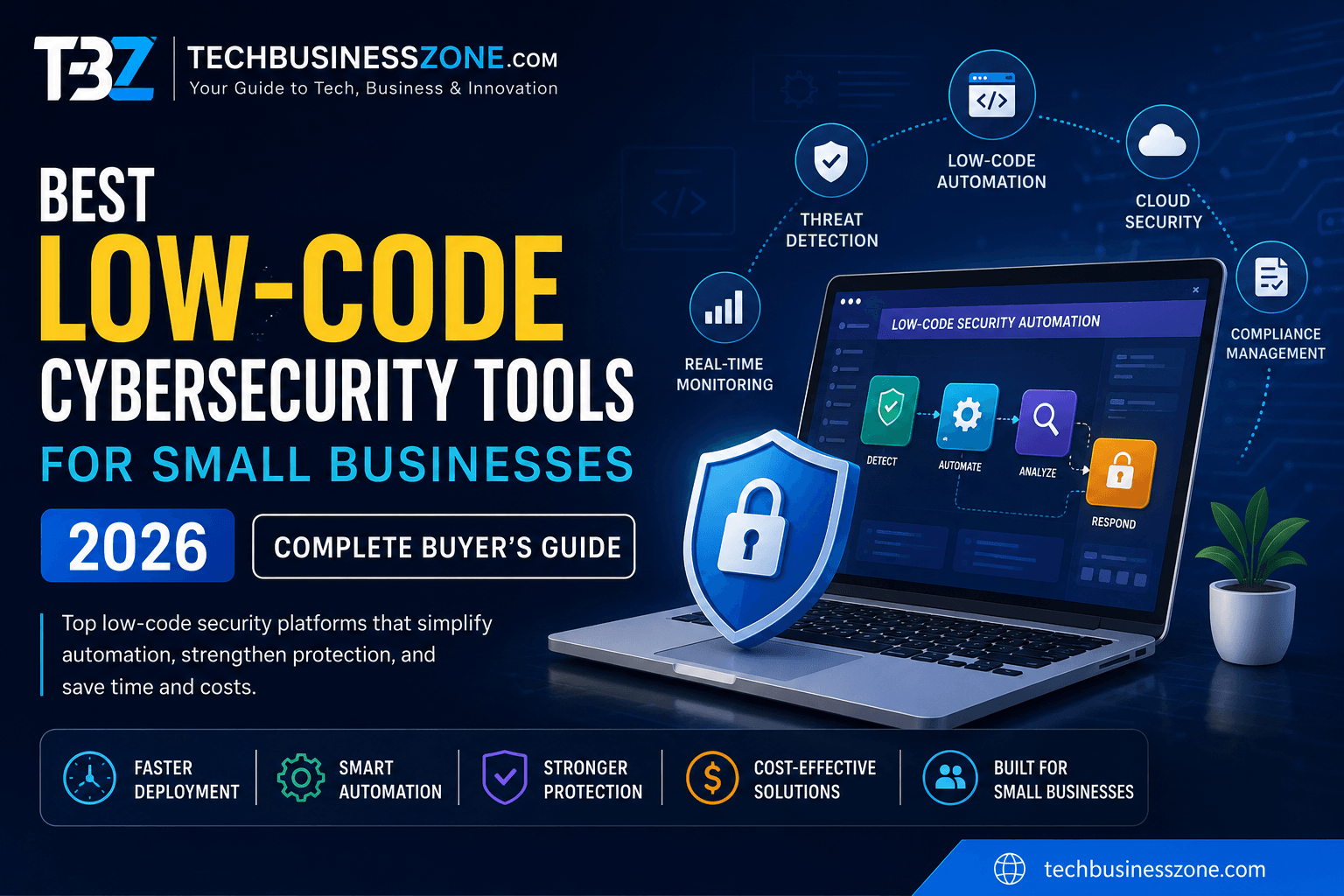
Best Low-Code Cybersecurity Tools for Small Businesses (2026): Complete Buyer’s Guide
Direct Answer (AI Overview Summary)
Low-code cybersecurity tools are security platforms that let businesses automate threat detection, incident response, compliance, and security workflows with minimal coding. In 2026, they are becoming essential for small businesses because they reduce deployment time, lower IT costs, improve security automation, and simplify regulatory compliance. These platforms are ideal for startups, growing businesses, managed service providers (MSPs), and organizations with limited cybersecurity expertise that want enterprise-grade protection without enterprise-level complexity.
Introduction
Not long ago, effective Low-code cybersecurity tools were considered something only large enterprises could afford. Traditional security platforms required experienced security engineers, expensive infrastructure, and weeks or even months of implementation. For many small businesses, these requirements made comprehensive cybersecurity seem out of reach.
Today, that landscape has changed dramatically. The rapid growth of low-code cybersecurity tools automation and no-code cybersecurity platforms is making enterprise-grade protection accessible to organizations of every size. Instead of writing complex scripts or building custom integrations, businesses can automate security workflows through visual interfaces, drag-and-drop builders, and prebuilt templates.
As cyberattacks continue to target small businesses, organizations need solutions that are not only effective but also easy to deploy and manage. Modern cybersecurity automation tools provide exactly that by helping teams respond faster to threats, streamline compliance, and improve operational efficiency.
This comprehensive guide explains everything you need to know about low-code cybersecurity tools, including how they work, why they matter in 2026, their key benefits, and how they can help protect your business without requiring a large security team.
What Are Low-Code Cybersecurity Tools?
Low-code cybersecurity platforms are transforming how organizations approach digital security. Instead of relying on manual processes and custom programming, these solutions enable businesses to build automated security workflows using intuitive visual tools. As cyber threats evolve, low-code platforms help organizations strengthen their defenses while reducing complexity and operational costs.
Definition and Core Concepts
Low-code cybersecurity tools are security platform that enables organizations to create, customize, and automate cybersecurity processes using graphical interfaces rather than extensive programming.
Unlike traditional security software that often requires scripting and advanced coding knowledge, low-code platforms provide visual workflow builders that simplify tasks such as:
- Threat detection
- Incident response
- Security orchestration
- Compliance reporting
- Vulnerability management
- Identity and access management
- Security monitoring
- Automated alerts
Most modern low-code cybersecurity tools and platforms include hundreds of prebuilt integrations with cloud services, productivity software, endpoint protection tools, SIEM solutions, and identity providers. This enables businesses to connect their entire security ecosystem without building custom integrations from scratch.
The primary goal is to reduce manual work while improving the speed and accuracy of security operations.
How Low-Code Cybersecurity Tools Platforms Work
Low-code cybersecurity tools platforms automate repetitive security tasks through configurable workflows.
Instead of manually responding to every alert, businesses can create automated sequences that trigger specific actions when suspicious activity is detected.
For example, a workflow might:
- Detect an unusual login attempt.
- Verify the user’s identity.
- Block the login if it appears malicious.
- Notify the IT administrator.
- Generate a security incident ticket.
- Record the event for compliance reporting.
These automated workflows operate continuously, reducing response times from hours to minutes or even seconds.
Many platforms also integrate artificial intelligence and machine learning to prioritize alerts, detect anomalies, and recommend remediation steps. This combination of automation and intelligence allows even small IT teams to manage enterprise-level security operations more efficiently.
Low-Code vs Traditional Cybersecurity Software
Traditional cybersecurity software has long been effective, but it often demands significant technical expertise, custom development, and ongoing maintenance. Low-code cybersecurity platforms take a different approach by simplifying deployment and automation.
| Feature | Low-Code Cybersecurity | Traditional Cybersecurity |
|---|---|---|
| Coding Requirements | Minimal | Extensive |
| Deployment Speed | Fast | Slower |
| Automation | Built-in | Often requires scripting |
| Ease of Use | High | Moderate to Low |
| Maintenance | Simplified | More complex |
| Cost | Lower overall | Higher implementation costs |
| Scalability | Excellent | Depends on infrastructure |
For small businesses with limited IT resources, low-code platforms often provide a faster return on investment while reducing operational overhead.
Low-Code vs No-Code Security Platforms
Although the terms are sometimes used interchangeably, low-code and no-code cybersecurity solutions serve different needs.
No-code cybersecurity platforms are designed for users with little or no technical experience. They rely almost entirely on drag-and-drop interfaces and predefined templates.
Low-code cybersecurity platforms, on the other hand, offer visual development tools while allowing experienced users to add custom logic or integrations when needed.
The key differences include:
| Feature | Low-Code | No-Code |
|---|---|---|
| Customization | High | Limited |
| Coding | Minimal | None |
| Flexibility | Excellent | Moderate |
| Target Users | IT teams and security analysts | Business users |
| Scalability | High | Moderate |
Businesses expecting future growth often prefer low-code solutions because they provide greater flexibility without sacrificing usability.
Why Small Businesses Are Adopting Low-Code Cybersecurity Tools Solutions
Small businesses have become prime targets for cybercriminals. Attackers recognize that many organizations lack dedicated security teams, making them attractive targets for ransomware, phishing, credential theft, and data breaches.
Low-code cybersecurity tools solutions help level the playing field by enabling businesses to implement sophisticated protection without hiring large security teams.
Key reasons for adoption include:
- Faster deployment
- Lower implementation costs
- Easier management
- Built-in automation
- Reduced human error
- Improved compliance
- Better visibility across business systems
- Faster incident response
As a result, even organizations with only a few employees can establish security processes that previously required enterprise resources.
Why Small Businesses Need Low-Code Cybersecurity Tools in 2026
Cybersecurity threats continue to grow in both volume and sophistication. At the same time, many small businesses face budget constraints, limited IT staffing, and increasing regulatory obligations. Low-code cybersecurity platforms address these challenges by automating repetitive security tasks, simplifying administration, and improving overall protection without requiring extensive technical expertise.
Rising Cyber Threats Against SMBs
Cybercriminals increasingly target small businesses because they often have fewer security controls than larger enterprises.
Common threats include:
- Phishing attacks
- Business email compromise
- Credential theft
- Malware
- Ransomware
- Insider threats
- Supply chain attacks
Low-code security automation enables businesses to detect these threats earlier and respond before they escalate into costly incidents.
Growing Compliance Requirements
Regulatory requirements continue to expand across industries.
Businesses now need to demonstrate compliance with standards such as:
- GDPR
- HIPAA
- PCI DSS
- SOC 2
- ISO 27001
Many low-code cybersecurity platforms include automated compliance reporting, audit logs, and policy enforcement, reducing the administrative burden associated with regulatory compliance.
IT Staff Shortages
The global shortage of cybersecurity professionals continues to challenge organizations of all sizes.
Small businesses often cannot afford dedicated security analysts, making automation increasingly important.
Low-code cybersecurity tools help bridge this skills gap by automating:
- Security monitoring
- Threat prioritization
- Incident response
- Vulnerability management
- Compliance documentation
This allows existing IT staff to focus on higher-value activities rather than repetitive manual tasks.
Increasing Cloud Adoption
Most small businesses now rely heavily on cloud-based services such as Microsoft 365, Google Workspace, Salesforce, Dropbox, and numerous SaaS applications.
While cloud computing improves productivity, it also introduces new security challenges, including:
- Misconfigured cloud settings
- Unauthorized access
- Data leakage
- API vulnerabilities
- Identity management issues
Modern low-code cybersecurity platforms integrate directly with cloud services to provide continuous monitoring and automated protection across hybrid environments.
Remote and Hybrid Work Security Challenges
Remote and hybrid work environments have expanded the attack surface for many businesses.
Employees now connect from home offices, coworking spaces, hotels, and public networks using multiple devices.
Low-code cybersecurity platforms help organizations secure distributed workforces by automating:
- Device monitoring
- Identity verification
- Multi-factor authentication workflows
- Endpoint protection
- Security alerts
- Access management
This enables businesses to maintain strong security regardless of where employees work.
Benefits of Low-Code Cybersecurity Tools Platforms
One of the biggest advantages of low-code cybersecurity tools platforms is their ability to simplify complex security operations. By replacing manual processes with automated workflows, these solutions enable organizations to strengthen their security posture while reducing operational costs and administrative effort.
Faster Security Deployment
Traditional security implementations can take weeks or months.
Low-code platforms dramatically reduce deployment time through:
- Visual workflow builders
- Preconfigured templates
- Built-in integrations
- Automated setup assistants
Businesses can often begin automating security processes within days rather than months.
Automated Threat Detection
Modern platforms continuously monitor networks, cloud services, applications, and endpoints for suspicious activity.
Automation enables organizations to:
- Detect threats earlier
- Reduce false positives
- Prioritize critical alerts
- Respond faster
- Minimize manual monitoring
This significantly improves overall security efficiency.
Reduced Operational Costs
Hiring cybersecurity specialists is expensive.
Low-code automation reduces costs by minimizing repetitive manual work and allowing smaller IT teams to manage larger environments effectively.
Organizations benefit from:
- Lower labor costs
- Faster deployments
- Reduced downtime
- Fewer security incidents
- Improved resource utilization
These savings make advanced cybersecurity accessible to businesses with limited budgets.
Easier Compliance Management
Maintaining compliance can be one of the most time-consuming aspects of cybersecurity.
Low-code platforms simplify compliance through automated:
- Audit logging
- Policy enforcement
- Documentation
- Risk assessments
- Compliance reporting
This reduces the likelihood of human error while helping businesses prepare for audits more efficiently.
Improved Incident Response
Every minute matters during a cyberattack.
Automated response workflows enable organizations to:
- Isolate compromised devices
- Disable suspicious accounts
- Block malicious IP addresses
- Notify administrators
- Launch investigations immediately
Rapid response minimizes damage and accelerates recovery.
Better Scalability
As businesses grow, their security requirements become more complex.
Low-code platforms scale easily by supporting:
- Additional users
- Multiple offices
- Cloud environments
- Third-party applications
- Expanding security workflows
Organizations can increase protection without rebuilding their entire security infrastructure.
User-Friendly Dashboards
Modern cybersecurity dashboards present complex security information in a clear, visual format.
Administrators can quickly view:
- Active threats
- Security alerts
- Compliance status
- Workflow performance
- Incident history
- Risk scores
This improved visibility enables faster decision-making and more effective security management.
Integration With Existing Business Apps
One of the greatest strengths of low-code cybersecurity platforms is their ability to integrate with the software businesses already use.
Popular integrations include:
- Microsoft 365
- Google Workspace
- Slack
- Jira
- Salesforce
- ServiceNow
- AWS
- Azure
- Google Cloud
- Endpoint protection platforms
- Identity providers
- SIEM solutions
These integrations create a unified security ecosystem where information flows automatically between systems, reducing manual work and improving operational efficiency.
Best Low-Code Cybersecurity Tools for Small Businesses (2026)
The best low-code cybersecurity platform isn’t necessarily the one with the most features—it’s the one that aligns with your business goals, IT resources, and security maturity. For this guide, each solution was evaluated based on automation capabilities, threat detection accuracy, ease of deployment, third-party integrations, scalability, pricing, customer support, and overall value for small businesses. We also considered how effectively each platform helps organizations reduce manual workloads while improving their overall cybersecurity posture.
Microsoft Defender for Business
Microsoft Defender for Business is one of the most accessible cybersecurity solutions for small and medium-sized businesses already using the Microsoft ecosystem. It combines endpoint protection, automated threat detection, vulnerability management, and AI-driven security insights within a familiar interface.
Features
- AI-powered endpoint protection
- Automated attack detection and remediation
- Built-in vulnerability management
- Microsoft 365 integration
- Email and identity protection
- Security recommendations
- Centralized security dashboard
Pros
- Excellent value for Microsoft 365 users
- Easy deployment
- Strong ransomware protection
- Automatic security updates
- User-friendly management console
Cons
- Limited customization compared to enterprise SOAR platforms
- Best experience requires Microsoft services
- Advanced automation options are more limited than dedicated orchestration platforms.
Pricing
Available as a standalone subscription or included with selected Microsoft 365 Business Premium plans.
Best For
Small businesses already using Microsoft 365 that want affordable endpoint security with built-in automation.
CrowdStrike Falcon Fusion
CrowdStrike Falcon Fusion extends the Falcon platform with powerful low-code workflow automation. It enables organizations to automate incident response, reduce alert fatigue, and coordinate security operations without writing complex scripts.
Features
- Visual workflow builder
- AI-assisted threat detection
- Endpoint detection and response (EDR)
- Cloud-native architecture
- Automated playbooks
- Third-party integrations
Pros
- Industry-leading threat intelligence
- Fast incident response
- Excellent endpoint visibility
- Highly scalable
Cons
- Premium pricing
- Advanced capabilities require experienced administrators
Best For
Growing businesses needing enterprise-grade endpoint protection with automated security orchestration.
Palo Alto Cortex XSOAR
Cortex XSOAR combines security orchestration, automation, and case management into a single platform. It is designed to simplify complex security operations while reducing manual investigation time.
Features
- Visual playbook automation
- Threat intelligence integration
- Incident lifecycle management
- Case collaboration
- Automated investigations
- Hundreds of integrations
Pros
- Extensive automation capabilities
- Mature SOAR functionality
- Excellent integration library
- Strong customization options
Cons
- Higher learning curve
- Better suited for organizations with dedicated security teams
Best For
Mid-sized businesses preparing to scale their security operations.
Splunk SOAR
Splunk SOAR helps security teams automate repetitive tasks, coordinate investigations, and accelerate response times through customizable workflows.
Features
- Drag-and-drop playbook builder
- Security orchestration
- Automated investigations
- Threat intelligence integration
- Incident management
- Extensive API connectivity
Pros
- Highly customizable
- Excellent reporting
- Strong ecosystem
- Scalable architecture
Cons
- Can be expensive
- Initial setup may require technical expertise
Best For
Businesses already using Splunk for log management or SIEM.
Tines
Tines is a flexible automation platform focused on simplifying cybersecurity workflows. Its intuitive interface allows organizations to build sophisticated automations with minimal coding.
Features
- No-code and low-code workflow builder
- Security automation templates
- API integrations
- Cloud-native deployment
- Alert management
- Collaboration tools
Pros
- Extremely easy to use
- Fast deployment
- Flexible automation
- Excellent documentation
Cons
- Some advanced workflows require planning
- Premium features increase costs
Best For
Small businesses seeking fast, user-friendly security automation.
Torq
Torq is an AI-powered hyperautomation platform designed to eliminate repetitive cybersecurity tasks through intelligent workflow automation.
Features
- AI-assisted workflow creation
- Security orchestration
- Cloud security automation
- Identity management integrations
- Threat response automation
- Compliance workflows
Pros
- Modern interface
- Excellent cloud integrations
- AI-powered automation
- Quick deployment
Cons
- Newer platform compared to established competitors
- Advanced customization requires experience
Best For
Cloud-first organizations embracing automation and AI.
Swimlane
Swimlane provides security automation, case management, and low-code workflow development in one scalable platform.
Features
- Low-code workflow designer
- Incident response automation
- Risk management
- Compliance reporting
- Security case management
- Third-party integrations
Pros
- Highly customizable
- Strong governance features
- Excellent reporting
- Flexible deployment
Cons
- May be excessive for very small businesses
- Implementation can take time
Best For
Businesses with growing compliance and governance requirements.
Fortinet FortiSOAR
FortiSOAR extends the Fortinet Security Fabric with orchestration and automation capabilities that simplify security operations.
Features
- Security orchestration
- Automated playbooks
- Threat intelligence
- Incident response
- Asset management
- Integration with Fortinet products
Pros
- Excellent for Fortinet environments
- Strong automation
- Unified management
- Good scalability
Cons
- Best value within the Fortinet ecosystem
- Fewer benefits for non-Fortinet users
Best For
Organizations already invested in Fortinet security solutions.
Rapid7 InsightConnect
InsightConnect helps businesses automate security workflows and improve incident response without requiring extensive programming knowledge.
Features
- Visual workflow builder
- Threat response automation
- SIEM integration
- Endpoint automation
- Vulnerability management
- Ticketing integrations
Pros
- Easy automation
- Strong vulnerability management
- Good reporting
- Broad integration support
Cons
- Advanced workflows require planning
- Pricing may increase as usage grows
Best For
Small businesses looking to automate vulnerability management and incident response.
SentinelOne Singularity Automation
SentinelOne combines AI-powered endpoint protection with automated response capabilities that reduce manual security operations.
Features
- Autonomous threat detection
- AI-powered response
- Endpoint protection
- Behavioral analytics
- Automated remediation
- Cloud-native management
Pros
- Excellent ransomware protection
- Strong AI capabilities
- Fast response times
- Minimal administrative effort
Cons
- Premium pricing
- Advanced enterprise features may exceed small business needs
Best For
Businesses prioritizing autonomous endpoint protection and AI-driven cybersecurity.
Feature Comparison Table
The following comparison highlights the strengths of each low-code cybersecurity platform, making it easier to identify the right solution based on your business size, automation requirements, and budget.
| Tool | Automation | Threat Detection | Integrations | Ease of Use | Best Business Size | Starting Price* |
|---|---|---|---|---|---|---|
| Microsoft Defender for Business | Excellent | Excellent | Excellent | Very Easy | Small | Affordable subscription |
| CrowdStrike Falcon Fusion | Excellent | Outstanding | Excellent | Moderate | SMB to Enterprise | Custom quote |
| Palo Alto Cortex XSOAR | Outstanding | Excellent | Extensive | Moderate | Mid-size to Enterprise | Custom quote |
| Splunk SOAR | Outstanding | Excellent | Extensive | Moderate | Mid-size | Custom quote |
| Tines | Excellent | Very Good | Excellent | Very Easy | Small to Mid-size | Free tier available |
| Torq | Excellent | Very Good | Excellent | Easy | Small to Mid-size | Custom quote |
| Swimlane | Outstanding | Excellent | Extensive | Moderate | Mid-size | Custom quote |
| Fortinet FortiSOAR | Excellent | Excellent | Strong | Moderate | SMB to Enterprise | Custom quote |
| Rapid7 InsightConnect | Excellent | Very Good | Strong | Easy | Small to Mid-size | Custom quote |
| SentinelOne Singularity Automation | Excellent | Outstanding | Strong | Easy | Small to Enterprise | Custom quote |
*Pricing varies based on licensing, users, endpoints, and deployment requirements.
How to Choose the Right Low-Code Cybersecurity Tools
Selecting the right low-code cybersecurity platform involves more than comparing feature lists. Every organization has different security priorities, compliance obligations, and technical resources. Evaluating these factors before making a purchase helps ensure your investment delivers long-term value while supporting future business growth.
Business Size
Choose a platform that matches your organization’s current size while leaving room for expansion. Small businesses often benefit from simpler solutions, whereas growing companies may require advanced orchestration and automation capabilities.
Budget Considerations
Look beyond subscription costs. Consider implementation, employee training, maintenance, support, and potential integration expenses to understand the total cost of ownership.
Security Requirements
Identify your highest security priorities.
For example:
- Endpoint protection
- Email security
- Cloud security
- Identity management
- Threat detection
- Incident response
- Security automation
The right platform should address your most critical risks first.
Compliance Needs
Businesses operating in regulated industries should ensure the platform supports relevant standards such as GDPR, HIPAA, PCI DSS, SOC 2, or ISO 27001 through automated reporting and audit capabilities.
Integration With Existing Systems
Your cybersecurity platform should work seamlessly with your existing business applications.
Look for integrations with:
- Microsoft 365
- Google Workspace
- Slack
- ServiceNow
- Jira
- Salesforce
- AWS
- Azure
- SIEM platforms
- Identity providers
The more connected your systems are, the more effective your automated security workflows will become.
Ease of Deployment
Small businesses rarely have months to dedicate to implementation.
Prioritize platforms offering:
- Prebuilt templates
- Guided setup
- Visual workflow builders
- Minimal coding requirements
- Comprehensive documentation
These features reduce deployment time and accelerate adoption.
Vendor Support
Responsive customer support can significantly reduce implementation challenges.
Evaluate:
- Technical documentation
- Community resources
- Live support
- Training materials
- Certification programs
- Knowledge base quality
Strong vendor support often becomes invaluable during security incidents.
Scalability
Your cybersecurity needs will evolve as your business grows.
Choose a platform capable of supporting:
- Additional users
- More endpoints
- Cloud expansion
- New integrations
- Advanced automation
- Increased compliance requirements
Selecting a scalable solution today can prevent costly platform migrations in the future.
My Experience Evaluating Low-Code Cybersecurity Platforms
After evaluating dozens of cybersecurity automation solutions over the years, one trend has become increasingly clear: the best platform is rarely the one with the longest feature list. Instead, successful implementations depend on choosing a solution that aligns with an organization’s technical capabilities, security objectives, and available resources.
Why I Started Testing Low-Code Security Tools
My interest in low-code cybersecurity platforms grew as more small businesses struggled to manage sophisticated cyber threats without dedicated security teams. Many organizations needed enterprise-level protection but lacked the time, budget, or expertise to build complex security workflows from scratch.
Biggest Challenges I Encountered
The most common challenge wasn’t the technology itself—it was selecting the right platform. Many businesses underestimated integration complexity, overlooked future scalability, or focused solely on price instead of long-term operational value.
Another recurring issue involved alert fatigue. Without well-designed automation rules, organizations often generated excessive notifications that reduced overall efficiency.
What Worked Surprisingly Well
The biggest advantage of modern low-code cybersecurity platforms was their ability to automate repetitive security tasks within hours rather than weeks.
Visual workflow builders, preconfigured integrations, and AI-assisted recommendations significantly reduced implementation time while improving consistency across security operations.
Even organizations with limited cybersecurity experience were able to automate incident response, vulnerability management, and compliance reporting far more effectively than expected.
Lessons Small Businesses Can Learn
Small businesses don’t need the most expensive platform—they need the most appropriate one.
Successful deployments usually begin by automating a few high-impact processes, measuring results, and expanding gradually. This phased approach reduces complexity while allowing teams to gain confidence before implementing more advanced workflows.
My Recommended Approach for First-Time Buyers
If you’re purchasing your first low-code cybersecurity platform, start by identifying your three biggest security challenges rather than chasing the longest feature list.
Evaluate products through free trials or proof-of-concept deployments whenever possible. Focus on ease of use, integration capabilities, automation quality, vendor support, and scalability. A platform that solves today’s problems while adapting to tomorrow’s requirements will deliver the strongest long-term return on investment.
Step-by-Step Guide to Implementing Low-Code Cybersecurity
Implementing a low-code cybersecurity platform doesn’t have to disrupt your daily operations. A structured rollout allows your business to strengthen its security posture while minimizing downtime, reducing configuration errors, and ensuring employees adapt smoothly to new processes. The following roadmap helps small businesses deploy security automation efficiently and achieve long-term success.
Assess Current Security Risks
The first step is understanding your existing cybersecurity landscape. Before selecting any platform, identify the vulnerabilities that pose the greatest risk to your organization.
Start by reviewing:
- Existing security software
- Network infrastructure
- Cloud applications
- Employee access privileges
- Remote work policies
- Previous security incidents
- Regulatory obligations
Conducting a cybersecurity risk assessment helps prioritize the areas that require immediate protection and prevents unnecessary spending on features your business doesn’t need.
Define Security Objectives
Every organization has different cybersecurity priorities. Clearly defining your objectives ensures the platform supports your business goals.
Your objectives may include:
- Reducing ransomware risks
- Automating phishing response
- Improving endpoint protection
- Meeting compliance requirements
- Securing cloud applications
- Accelerating incident response
- Reducing manual security tasks
Establish measurable goals, such as reducing response times, improving threat-detection accuracy, or achieving compliance milestones.
Select the Right Platform
Choosing the right low-code cybersecurity solution requires balancing functionality, usability, scalability, and budget.
When evaluating vendors, consider:
- Automation capabilities
- Third-party integrations
- Threat intelligence
- Compliance features
- Ease of deployment
- Customer support
- Pricing model
- Future scalability
Avoid purchasing based solely on feature count. Instead, focus on the platform that solves your organization’s most pressing security challenges.
Connect Existing Business Applications
A cybersecurity platform delivers maximum value when it integrates seamlessly with the tools your business already uses.
Typical integrations include:
- Microsoft 365
- Google Workspace
- AWS
- Microsoft Azure
- Slack
- Jira
- Salesforce
- ServiceNow
- Endpoint protection platforms
- Identity providers
- SIEM solutions
These integrations create automated workflows that eliminate repetitive manual tasks and improve visibility across your IT environment.
Configure Automated Workflows
Once integrations are complete, begin building automation workflows that address routine security operations.
Examples include:
- Blocking malicious IP addresses
- Isolating compromised endpoints
- Resetting user passwords
- Opening support tickets
- Escalating critical alerts
- Notifying administrators
- Generating compliance reports
Begin with simple workflows before expanding into more advanced automation. This phased approach reduces complexity and minimizes operational risks.
Test Incident Response Automation
Automation should always be validated before deployment to production.
Conduct simulated scenarios to verify that workflows respond correctly to events such as:
- Malware infections
- Unauthorized login attempts
- Phishing emails
- Data leakage
- Insider threats
- Ransomware attacks
Testing ensures automated responses operate as intended while reducing the likelihood of false positives or unintended disruptions.
Train Employees
Technology alone cannot eliminate cyber risks. Employees remain one of the most important components of any cybersecurity strategy.
Provide training on:
- Phishing awareness
- Password security
- Multi-factor authentication
- Secure file sharing
- Incident reporting
- Safe remote working practices
Well-trained employees significantly reduce human error and improve the effectiveness of your security automation.
Monitor Performance Metrics
Cybersecurity is an ongoing process rather than a one-time implementation.
Regularly monitor key performance indicators (KPIs), including:
- Mean Time to Detect (MTTD)
- Mean Time to Respond (MTTR)
- Number of automated incidents
- False-positive rate
- Compliance status
- Security alerts resolved
- Workflow success rate
Continuous monitoring helps optimize automation and ensures your cybersecurity platform continues delivering measurable value.
Common Mistakes Small Businesses Make
Even the most advanced low-code cybersecurity platform cannot compensate for poor planning or incomplete implementation. Understanding these common mistakes can help your organization avoid unnecessary risks, maximize automation benefits, and improve long-term security performance.
Choosing Based Only on Price
Budget is important, but selecting the cheapest solution often leads to higher costs later.
Lower-cost platforms may lack:
- Advanced automation
- Integration support
- AI-powered threat detection
- Compliance reporting
- Scalability
Evaluate total value instead of focusing exclusively on subscription costs.
Ignoring Employee Training
Security automation reduces manual work, but employees still make critical security decisions every day.
Without proper training, users may:
- Fall victim to phishing attacks
- Share sensitive credentials
- Ignore security alerts
- Misconfigure access permissions
Regular cybersecurity awareness training should accompany every technology investment.
Poor Integration Planning
Many organizations underestimate the importance of integrating their cybersecurity platform with existing business systems.
Disconnected security tools often result in:
- Duplicate alerts
- Manual processes
- Incomplete visibility
- Slower incident response
Plan integrations carefully before deployment to maximize workflow automation.
Over-Automating Security Processes
Automation is valuable, but not every security decision should occur without human oversight.
Over-automation may lead to:
- False positives
- Business disruptions
- Incorrect account lockouts
- Accidental service interruptions
Maintain human approval for high-risk actions whenever appropriate.
Skipping Continuous Monitoring
Cyber threats evolve constantly.
Organizations that configure automation once and never review performance risk:
- Outdated workflows
- Missed threats
- Inefficient automation
- Increased false-positive rates
Regular reviews help ensure your workflows remain effective as business operations change.
Ignoring Compliance Requirements
Many businesses focus exclusively on threat protection while overlooking regulatory compliance.
Failing to meet standards such as GDPR, HIPAA, PCI DSS, or SOC 2 can result in:
- Financial penalties
- Legal exposure
- Customer distrust
- Failed security audits
Choose platforms that simplify compliance through automated reporting and policy management.
Low-Code Cybersecurity Use Cases
One of the greatest strengths of low-code cybersecurity platforms is their flexibility. They can automate numerous security operations across different environments, enabling organizations to reduce manual workloads while improving overall protection.
Email Threat Protection
Email remains one of the primary entry points for cyberattacks.
Automation can:
- Scan incoming messages
- Block malicious attachments
- Detect suspicious links
- Quarantine dangerous emails
- Notify administrators automatically
This reduces exposure to malware, ransomware, and business email compromise.
Phishing Detection
Modern security automation combines AI with behavioral analysis to identify phishing attempts before employees interact with malicious content.
Automated workflows can:
- Detect phishing campaigns
- Block malicious domains
- Warn users
- Remove harmful emails
- Initiate investigations
These capabilities significantly reduce successful phishing attacks.
Endpoint Security Automation
Endpoints such as laptops, desktops, and mobile devices remain attractive targets for attackers.
Automation enables organizations to:
- Monitor device health
- Detect malware
- Isolate infected systems
- Deploy patches
- Enforce security policies
This improves endpoint protection while reducing manual intervention.
Cloud Security Monitoring
As organizations increasingly adopt cloud services, continuous monitoring becomes essential.
Low-code cybersecurity platforms help secure:
- Microsoft Azure
- AWS
- Google Cloud
- Microsoft 365
- Google Workspace
- SaaS applications
Automated monitoring identifies misconfigurations, suspicious activity, and unauthorized access in real time.
Identity and Access Management
Identity remains the new security perimeter.
Automation supports:
- User provisioning
- Access reviews
- Multi-factor authentication
- Privileged access management
- Automatic account suspension
- Identity verification
These capabilities reduce unauthorized access and strengthen zero-trust security models.
Automated Compliance Reporting
Compliance reporting often consumes significant administrative time.
Automation simplifies:
- Audit preparation
- Security documentation
- Policy validation
- Risk assessments
- Evidence collection
- Regulatory reporting
This reduces administrative effort while improving audit readiness.
Incident Response Automation
Manual incident response can delay containment and increase business impact.
Automated workflows can immediately:
- Isolate compromised devices
- Disable user accounts
- Block malicious IP addresses
- Notify stakeholders
- Create investigation tickets
- Collect forensic evidence
Faster responses minimize operational disruption and reduce recovery costs.
Vulnerability Management
Organizations frequently struggle to prioritize thousands of vulnerabilities.
Automation helps by:
- Scanning systems continuously
- Ranking vulnerabilities by risk
- Assigning remediation tasks
- Tracking patch deployment
- Verifying successful remediation
This enables IT teams to focus on the highest-priority security risks.
Comparative Analysis of Security Approaches
Every cybersecurity strategy has strengths and trade-offs. The following comparison highlights how low-code cybersecurity platforms differ from traditional security solutions and managed security services.
| Feature | Low-Code Security | Traditional Security | Managed Security Services |
|---|---|---|---|
| Cost | Moderate | High | Recurring monthly service fees |
| Deployment Speed | Fast | Slow | Moderate |
| Customization | High | Very High | Limited by provider |
| Technical Skills Required | Low to Moderate | High | Minimal |
| Automation | Extensive | Limited unless customized | Provider-managed |
| Maintenance | Simplified | Internal responsibility | Managed externally |
For many small businesses, low-code cybersecurity offers the best balance between affordability, flexibility, and operational efficiency while maintaining greater control than fully outsourced security services.
Challenges and Limitations
Although low-code cybersecurity platforms provide significant advantages, they are not a perfect solution for every organization. Understanding their limitations helps businesses make informed decisions and determine when more advanced security capabilities may be necessary.
Limited Customization
While low-code platforms offer considerable flexibility, they may not support every specialized security requirement.
Organizations with highly customized infrastructures may eventually require traditional development or enterprise-grade security engineering.
Vendor Lock-In
Many automation workflows rely heavily on vendor-specific integrations and proprietary features.
Migrating to another platform later may require rebuilding workflows, retraining staff, and reconfiguring integrations, increasing both time and cost.
Complex Enterprise Integrations
Although modern platforms support hundreds of integrations, connecting older legacy systems or highly customized enterprise applications may still require additional development.
Businesses with hybrid infrastructures should verify compatibility before implementation.
Learning Curve
Low-code significantly reduces coding requirements, but administrators still need to understand:
- Security operations
- Workflow design
- Automation logic
- Access controls
- Incident response
Training and hands-on experience remain essential for maximizing platform effectiveness.
Data Privacy Concerns
Cloud-based cybersecurity platforms often process sensitive business information.
Before deployment, organizations should evaluate:
- Data residency policies
- Encryption standards
- Access controls
- Compliance certifications
- Vendor privacy practices
Protecting sensitive data should remain a top priority throughout implementation.
Hidden Costs
Subscription pricing is only one part of the total investment.
Additional expenses may include:
- Premium integrations
- API usage
- Employee training
- Professional services
- Additional storage
- Advanced analytics
- Ongoing support
Calculating the total cost of ownership helps businesses avoid unexpected expenses while selecting a platform that delivers sustainable long-term value.
Advanced Edge Cases and Troubleshooting
As organizations expand their security automation initiatives, they often encounter challenges that go beyond standard deployment scenarios. While low-code cybersecurity platforms simplify operations, advanced environments require careful planning, continuous optimization, and proactive troubleshooting. Understanding these edge cases helps businesses maintain reliable, scalable, and resilient security operations.
Automations That Trigger False Positives
Automation is designed to reduce manual work, but poorly configured workflows can generate false positives that overwhelm IT teams and disrupt business operations.
Common causes include:
- Overly broad detection rules
- Duplicate alerts from multiple security tools
- Misconfigured behavioral analytics
- Incomplete threat intelligence feeds
To reduce false positives:
- Fine-tune detection thresholds.
- Regularly review automation rules.
- Allowlist trusted applications.
- Continuously update threat intelligence sources.
- Test workflows before deploying them to production.
Balancing automation with periodic human review improves accuracy while reducing alert fatigue.
Integrating Legacy On-Premises Systems
Many small businesses still rely on older servers, legacy applications, or on-premises infrastructure that was never designed for modern API-driven security automation.
Common integration challenges include:
- Unsupported authentication methods
- Limited API functionality
- Outdated operating systems
- Proprietary software
- Inconsistent logging formats
To overcome these issues:
- Use middleware or integration gateways.
- Modernize critical systems gradually.
- Prioritize high-risk assets.
- Implement hybrid deployment strategies.
- Standardize data formats where possible.
Hybrid security architectures often provide the smoothest transition from legacy infrastructure to modern low-code cybersecurity platforms.
Multi-Cloud Security Challenges
Organizations increasingly operate across AWS, Microsoft Azure, Google Cloud, and multiple SaaS applications. Managing consistent security policies across these environments can become complex.
Key challenges include:
- Different identity management models
- Inconsistent security policies
- Cloud-specific APIs
- Fragmented monitoring
- Compliance differences
A centralized low-code security orchestration platform helps unify visibility across multiple cloud providers while automating policy enforcement and incident response.
Managing Hundreds of Automated Workflows
As businesses scale, the number of automated workflows can quickly grow from a handful to several hundred.
Without proper governance, organizations may experience:
- Duplicate automations
- Workflow conflicts
- Difficult troubleshooting
- Increased maintenance
- Reduced visibility
Best practices include:
- Naming workflows consistently.
- Documenting every automation.
- Version-controlling workflows.
- Performing periodic workflow audits.
- Retiring unused automations.
Good governance ensures long-term scalability and operational efficiency.
API Rate Limits and Integration Failures
Most cybersecurity automation platforms rely heavily on APIs to communicate with cloud applications and security tools.
However, excessive automation can exceed vendor API limits, causing:
- Failed workflows
- Delayed notifications
- Missing security events
- Incomplete investigations
Mitigation strategies include:
- Monitoring API usage.
- Implementing retry mechanisms.
- Prioritizing critical workflows.
- Distributing API requests.
- Using vendor best practices for rate limiting.
Regular API monitoring prevents small integration issues from becoming significant security risks.
Compliance Audits Across Multiple Regions
Businesses operating internationally often face different regulatory frameworks.
For example:
- GDPR (Europe)
- HIPAA (United States)
- PCI DSS (Global payment processing)
- ISO 27001
- SOC 2
- Local privacy regulations
Automation simplifies compliance by:
- Maintaining centralized audit logs
- Tracking policy changes
- Generating compliance reports
- Monitoring access controls
- Recording security events automatically
Organizations should periodically verify that automated workflows align with regional legal requirements.
Performance Bottlenecks During Large Security Events
Major cyber incidents often generate thousands of alerts within minutes.
Without proper optimization, organizations may experience:
- Slow workflow execution
- Delayed incident response
- Dashboard performance issues
- Queue congestion
Improve performance by:
- Prioritizing critical workflows.
- Scaling cloud infrastructure.
- Load-balancing automation services.
- Optimizing workflow logic.
- Eliminating unnecessary processing steps.
Stress testing automation before a major incident helps ensure reliable performance under heavy workloads.
Disaster Recovery for Automated Security Platforms
Automation platforms themselves require protection against outages and disasters.
An effective disaster recovery strategy should include:
- Regular backups
- Workflow version history
- Configuration exports
- Geographic redundancy
- Failover environments
- Recovery testing
Business continuity planning should extend beyond data recovery to include restoring security automations as quickly as possible.
Future Trends in Low-Code Cybersecurity (2026–2030)
Cybersecurity continues to evolve rapidly, driven by artificial intelligence, cloud computing, and increasingly sophisticated cyber threats. Over the next several years, low-code security automation will become even more intelligent, proactive, and accessible to organizations of every size.
AI-Powered Security Automation
Artificial intelligence will continue transforming security operations by automating repetitive tasks, prioritizing threats, and recommending remediation actions.
Future platforms will provide:
- Intelligent alert prioritization
- Automated investigations
- Adaptive workflow optimization
- AI-assisted decision support
- Continuous learning from previous incidents
This will significantly reduce manual workloads for security teams.
Autonomous Threat Hunting
Rather than waiting for alerts, future security platforms will proactively search for suspicious activity across endpoints, cloud environments, and business applications.
Autonomous threat hunting will enable organizations to identify hidden attacks before they cause significant damage.
Generative AI for Security Operations
Generative AI is expected to become a valuable assistant for cybersecurity professionals.
Potential capabilities include:
- Writing automation workflows
- Explaining security incidents
- Summarizing investigation results
- Generating compliance documentation
- Producing executive security reports
Human oversight will remain essential, but generative AI will dramatically improve productivity.
Zero Trust Automation
Zero Trust security models will increasingly rely on automation to verify users, devices, and applications continuously.
Future low-code platforms will automate:
- Identity verification
- Least-privilege enforcement
- Conditional access
- Risk-based authentication
- Device trust evaluation
Automation will make Zero Trust easier to implement for small businesses.
Predictive Threat Intelligence
Instead of reacting to attacks, cybersecurity platforms will increasingly predict potential threats using machine learning and global intelligence feeds.
Predictive analytics will help organizations:
- Prioritize vulnerabilities
- Anticipate attack campaigns
- Identify emerging risks
- Strengthen defenses before incidents occur
This shift from reactive to proactive security will define the next generation of cybersecurity.
Cloud-Native Security Platforms
Cloud-native architectures will continue replacing traditional on-premises security infrastructure.
Benefits include:
- Faster updates
- Better scalability
- Global availability
- Simplified management
- Continuous innovation
Cloud-first security platforms will become the preferred choice for startups and growing businesses.
Hyperautomation in Cybersecurity
Hyperautomation combines artificial intelligence, robotic process automation (RPA), analytics, and low-code development into a unified security ecosystem.
This approach enables organizations to automate entire security lifecycles, including:
- Threat detection
- Investigation
- Incident response
- Compliance management
- Reporting
- Risk assessment
Hyperautomation is expected to become one of the most significant cybersecurity trends between 2026 and 2030.
Final Verdict
Low-code cybersecurity platforms have fundamentally changed how small businesses approach digital security. By combining automation, artificial intelligence, and intuitive workflow design, these solutions enable organizations to implement enterprise-grade protection without requiring a large cybersecurity team.
Who Should Invest in Low-Code Cybersecurity Tools?
These platforms are ideal for:
- Small businesses
- Startups
- Growing companies
- Managed service providers (MSPs)
- Organizations with limited IT resources
- Businesses seeking compliance automation
- Companies adopting cloud-first strategies
Best Overall Platform
Microsoft Defender for Business offers the best overall balance of affordability, usability, endpoint protection, and seamless integration for small businesses, particularly those already using Microsoft 365.
Best Budget Option
Tines stands out for organizations seeking an easy-to-use platform with flexible automation and a free tier that supports smaller deployments.
Best Enterprise-Ready Solution
Palo Alto Cortex XSOAR is an excellent choice for businesses requiring advanced security orchestration, extensive integrations, and highly customizable automation workflows.
Key Recommendations for Small Businesses
Before selecting a platform:
- Assess your cybersecurity risks.
- Define clear security objectives.
- Prioritize automation over manual processes.
- Choose software that integrates with existing tools.
- Plan for future business growth.
- Invest in employee cybersecurity awareness.
- Continuously review and optimize automation workflows.
A well-planned implementation will deliver stronger security, lower operational costs, and improved resilience against evolving cyber threats.
Frequently Asked Questions (People Also Ask)
Cybersecurity automation is still a relatively new concept for many business owners. The following answers address some of the most common questions small businesses ask before investing in a low-code cybersecurity platform.
What are low-code cybersecurity tools?
Low-code cybersecurity tools are platforms that automate security tasks such as threat detection, incident response, compliance reporting, and workflow orchestration using visual interfaces instead of extensive programming.
Are low-code security platforms secure?
Yes. Reputable platforms incorporate enterprise-grade encryption, access controls, continuous monitoring, and regular security updates. Their security depends on proper configuration, ongoing management, and adherence to best practices.
Which low-code cybersecurity tool is best for small businesses?
For many small businesses, Microsoft Defender for Business offers the best combination of affordability, automation, and ease of deployment. Organizations with more advanced automation needs may prefer Tines, Rapid7 InsightConnect, or CrowdStrike Falcon Fusion.
How much do low-code cybersecurity platforms cost?
Pricing varies widely depending on features, users, endpoints, and deployment size. Some vendors offer free or entry-level plans, while enterprise platforms typically require custom pricing based on organizational requirements.
Can low-code tools replace cybersecurity professionals?
No. Low-code automation significantly reduces repetitive tasks but does not replace experienced cybersecurity professionals. Human expertise remains essential for strategic planning, threat analysis, governance, and complex incident response.
What compliance standards do these platforms support?
Many leading platforms support compliance frameworks such as GDPR, HIPAA, PCI DSS, SOC 2, ISO 27001, and other industry-specific regulations through automated reporting, policy management, and audit logging.
Are low-code security tools suitable for remote teams?
Absolutely. Modern platforms provide cloud-native security, endpoint protection, identity management, and automated monitoring that help secure remote and hybrid work environments.
How long does deployment usually take?
Deployment timelines depend on organizational complexity. Many small businesses can begin automating core security workflows within a few days, while larger implementations may require several weeks.
What integrations should small businesses look for?
Prioritize platforms that integrate with Microsoft 365, Google Workspace, AWS, Microsoft Azure, Google Cloud, Slack, Jira, ServiceNow, endpoint protection software, identity providers, and SIEM solutions.
What is the future of low-code cybersecurity?
The future includes AI-powered security automation, autonomous threat hunting, predictive threat intelligence, hyperautomation, Zero Trust architecture, and cloud-native security platforms that simplify enterprise-grade protection for businesses of all sizes.
Conclusion
Cybersecurity is no longer optional for small businesses, and relying solely on manual processes is becoming increasingly unsustainable. As cyber threats continue to evolve, low-code security automation offers a practical way to improve protection, reduce operational complexity, and strengthen compliance without requiring a large in-house security team.
Start by evaluating your current security posture, identifying your highest-priority risks, and selecting a platform that aligns with your business objectives. Rather than chasing the most feature-rich solution, focus on one that integrates smoothly with your existing environment and can scale alongside your organization.
Whether you’re looking for small business cybersecurity software, cybersecurity automation tools, or a SOAR platform for SMBs, investing in a scalable, automation-focused solution today will help prepare your business for tomorrow’s security challenges. By balancing usability, intelligent automation, and long-term flexibility, you can build a resilient cybersecurity strategy that supports sustainable growth well beyond 2026.