10 Anti-Counterfeiting Technology Companies to Know in 2026
Counterfeit products are not solved by putting a hologram or QR code on a package. Modern anti-counterfeiting programs can combine physical security features, covert markers, digital authentication, serialization, RFID/NFC, track-and-trace systems, and other technologies. The right solution depends on what a company is trying to protect, how products move through the supply chain, and how authenticity needs to be verified. This guide examines 10 anti-counterfeiting technology companies worth knowing in 2026, but it is not a ranking or endorsement.
The companies are included because they represent important parts of the current anti-counterfeiting ecosystem, including security inks, covert authentication, digital product identity, RFID, serialization, smart labels, and product verification.
What Is Anti-Counterfeiting Technology?
Anti-counterfeiting technology is a broad term for technologies and physical security measures designed to make products, packaging, documents, or materials harder to copy and easier to authenticate.
The technology can answer different questions:
Authentication: Is this product genuine?
Identification: Which individual product or item is this?
Traceability: Where has this product been during its journey through the supply chain?
Tamper detection: Has somebody opened, altered, or replaced the contents?
These are related problems, but they are not identical. A hologram may help a person visually inspect packaging, while RFID can provide item identification and supply-chain visibility. A covert chemical marker may be useful to an investigator but invisible to an ordinary consumer.
The European Union Intellectual Property Office’s anti-counterfeiting technology guide illustrates how broad this field has become, covering electronic technologies such as RFID and NFC, mechanical technologies, machine-readable codes, holograms, security inks, watermarks, microtext, DNA coding, chemical tracers, digital fingerprinting, and other techniques.
10 Anti-Counterfeiting Technology Companies to Know
There is no universally “best” anti-counterfeiting company. A pharmaceutical manufacturer may need serialization and verification, while a luxury brand may prioritize NFC or covert authentication. A government security-printing operation has very different requirements, again.
The companies below therefore represent different approaches rather than a simple first-to-tenth ranking.
| Company | Main technology area | Authentication approach | Common applications |
|---|---|---|---|
| SICPA | Security inks, authentication, traceability | Physical + digital | Government, pharmaceuticals, regulated products |
| Authentix | Markers and authentication | Covert + digital | Regulated goods, fuel, pharmaceuticals |
| Avery Dennison | RFID, NFC and intelligent labels | Digital/connected | Retail, logistics, consumer products |
| Systech | Digital authentication and serialization | Digital | Pharmaceuticals, manufacturing |
| Scantrust | Secure QR codes | Digital | Consumer products, packaging |
| AlpVision | Invisible digital marking | Covert/digital | Packaging, printed materials |
| Applied DNA Sciences | DNA-based authentication | Molecular/covert | High-value and regulated goods |
| Zebra Technologies | RFID, barcode, printing and data capture | Identification infrastructure | Manufacturing, logistics, retail |
| CCL Industries | Security labels and packaging | Physical + integrated features | Pharmaceuticals, consumer goods |
| 3M | Security materials and packaging | Physical/material | Packaging and industrial applications |
Important: These companies do not all solve the same problem. A company specializing in RFID infrastructure should not be evaluated using the same criteria as a company specializing in covert chemical markers or security inks.
1. SICPA
Core areas: Security inks, authentication, traceability, brand protection, and secure identification.
SICPA is one of the long-established names in security printing and authentication technology. Its technology portfolio includes security inks and solutions designed for applications where authenticity, identification, and traceability are important.
Its work extends beyond ordinary commercial packaging into areas such as government documents, banknotes, tax-related applications, pharmaceuticals, and brand protection.
Where SICPA Fits
SICPA can be relevant when a security program needs multiple layers of physical and digital authentication, rather than relying on a single visible feature.
Potential fit: Government, pharmaceuticals, regulated products, tax-related products, consumer goods, and other high-value or high-risk applications.
2. Authentix
Core areas: Chemical markers, covert authentication, digital authentication, and track-and-trace.
Authentix represents a different side of the anti-counterfeiting market. Instead of focusing primarily on something a consumer can see on packaging, its approach includes technologies that can help establish product identity through covert or difficult-to-replicate markers.
Why Covert Authentication Matters
A visible security feature can tell a counterfeiter what needs to be copied. A covert feature can provide another layer that is not obvious from the outside.
That can be particularly useful when products need verification by inspectors, investigators, manufacturers, or authorized partners.
Potential fit: Regulated goods, fuel and lubricants, pharmaceuticals, government applications, and products requiring field verification.
3. Avery Dennison
Core areas: RFID, NFC, intelligent labels, digital identification and smart packaging.
Avery Dennison is better known to many businesses as a labeling and materials company, but its RFID and NFC technologies increasingly overlap with connected product identification.
Its technologies can give physical products a digital identity that can be used for identification, inventory management, supply-chain visibility, and, depending on the implementation, authentication.
Important Distinction
RFID is not automatically an anti-counterfeiting solution.
Its effectiveness depends on how the tag, product identity, backend system, and verification process are designed.
Potential fit: Retail, apparel, logistics, consumer products, and supply chains where identification and visibility are already important.
4. Systech
Core areas: Digital product authentication, serialization, and product identity.
Systech is associated with digital approaches to product authentication and serialization. This is particularly relevant to industries where individual products need unique identities and where manufacturers need to establish relationships between physical products and digital records.
Why Serialization Matters
Serialization gives individual items a unique identity rather than treating every package as interchangeable.
For example:
Product → unique identifier → digital record → verification event
That structure can support authentication, supply-chain monitoring, and regulatory processes.
Potential fit: Pharmaceuticals, healthcare products, manufacturing and other industries requiring item-level identification.
5. Scantrust
Core areas: Secure QR codes, digital authentication, product verification, and traceability.
Scantrust focuses heavily on secure QR-code-based product authentication and connected packaging.
Its platform allows businesses to create secure QR codes and connect products with digital information.
Are QR Codes Enough to Stop Counterfeiting?
No.
A normal QR code is simply a machine-readable representation of information. If the same code can be photographed and reproduced, copying the visual code does not necessarily prove that the physical product is genuine.
Secure QR implementations attempt to add authentication and backend intelligence around the code.
That makes the system behind the QR code just as important as the printed mark itself.
Potential fit: Consumer brands, packaging, food and beverage, industrial products, and businesses wanting smartphone-based verification.
6. AlpVision
Core areas: Invisible digital markings and authentication.
AlpVision takes another approach: integrating digital security features into printed materials without necessarily requiring a large visible security label.
Its technology is associated with invisible or covert digital markings that can be detected using appropriate imaging or verification methods.
Why Invisible Marking Can Be Useful
A visible security label can become a design element that counterfeiters know to reproduce.
An invisible or difficult-to-detect marker can provide an additional authentication layer without significantly changing the appearance of the product.
Potential fit: Packaging, printed materials, pharmaceuticals, consumer products, and applications where integration with existing artwork is important.
7. Applied DNA Sciences
Core areas: DNA-based authentication, molecular tagging and traceability.
Applied DNA Sciences represents the molecular side of product authentication.
DNA-based approaches can be used to create identifiers that are extremely difficult to reproduce correctly without access to the relevant authentication system.
Why Molecular Authentication Is Different
A hologram can be visually inspected.
A QR code can be scanned.
An RFID tag can be read.
A molecular marker operates at a completely different level and can be particularly useful where a high-security authentication layer is required.
However, specialized technologies can also introduce additional implementation and verification requirements.
Potential fit: High-value products, regulated goods, supply-chain security and applications requiring forensic or covert verification.
8. Zebra Technologies
Core areas: Identification, barcode and RFID technologies, printing, scanning and track-and-trace infrastructure.
Zebra Technologies is an important company to understand because anti-counterfeiting programs often depend on more than an authentication feature.
Businesses also need to print, encode, scan, identify, and track products.
Zebra provides technologies used across identification and data-capture workflows, including barcode and RFID systems.
Why This Matters
Consider a serialized product.
The security system may generate the identity, but a real manufacturing operation still needs hardware and software to:
- Print or encode the identifier
- Read it
- Associate it with production data
- Track it through the supply chain
- Verify it at the appropriate points
This makes identification infrastructure an important part of the wider anti-counterfeiting ecosystem.
Potential fit: Manufacturing, logistics, healthcare, retail, warehouses and supply-chain operations.
9. CCL Industries
Core areas: Security labels, specialty labels, packaging and authentication solutions.
CCL Industries is another major player associated with security labeling and anti-counterfeit packaging.
Security labels can incorporate multiple features rather than relying on one mechanism.
That matters because a layered security design can make it harder for a counterfeiter to reproduce the complete authentication system.
Potential fit: Pharmaceuticals, consumer products, packaging, regulated goods, and brand protection.
10. 3M
Core areas: Security materials, films, labels, and packaging-related technologies.
3M is another diversified technology company whose materials and security-related technologies can play a role in anti-counterfeiting and tamper-evident applications.
Its relevance illustrates an important point: not every company involved in anti-counterfeiting is a specialist authentication software provider.
Some companies contribute materials, films, labels, adhesives, or packaging technologies that form part of a broader security system.
Potential fit: Packaging, industrial products, consumer goods, and applications requiring specialized security or tamper-evident materials.
Anti-Counterfeiting Technology Comparison
| Technology | Consumer authentication | Supply-chain tracking | Tamper evidence | Item-level identity | Typical complexity |
|---|---|---|---|---|---|
| Standard QR | High | Low–Medium | Low | Medium | Low |
| Secure QR | High | Medium–High | Low | High | Low–Medium |
| RFID | Low–Medium | High | Low | High | Medium |
| NFC | High | Medium | Low | High | Medium |
| Hologram | Medium | Low | Low–Medium | Low | Medium |
| Security ink | Low–Medium | Low | Low | Low–Medium | Medium–High |
| Digital/invisible marking | Medium–High | Medium | Low | High | Medium |
| Serialization | Medium | High | Low | High | Medium–High |
| DNA/taggant authentication | Low–Medium | Medium | Low | High | High |
Note: This is a general technology comparison. Actual capabilities vary by implementation, vendor, product, and security architecture.
The Main Types of Anti-Counterfeiting Technology
Understanding the technology is more useful than memorizing company names.
Holograms and Optical Security Features
Holograms, optical effects, and security films can provide visible authentication features.
Their advantage is simplicity: consumers and inspectors can often recognize that a security feature exists.
The limitation is equally important. A visible feature can potentially be photographed, copied, or reproduced.
Therefore, holograms are often more useful as one layer of a security system rather than the entire system.
Security Inks
Security inks can contain properties that are difficult to reproduce using ordinary printing processes.
Examples include inks that respond to ultraviolet or infrared illumination and other specialized security features.
These technologies are particularly relevant to secure documents, regulated products, labels, and packaging.
Secure QR Codes
QR codes are inexpensive, familiar, and easy to scan.
But a normal QR code is not automatically secure.
The stronger approach is to associate a product-specific identity with the code and use a backend system to evaluate verification events.
This can allow a brand to identify unusual scanning behavior or determine whether the same identity appears in unexpected locations.
Secure QR approaches are therefore different from simply printing a website URL as a QR code.
RFID
RFID can provide automated product identification without requiring line-of-sight scanning in many implementations.
That makes it useful for warehouses, logistics, and inventory management.
It can also contribute to authentication when the tag identity, backend system, and verification process are designed appropriately.
NFC
NFC allows short-range communication between a tag and a compatible device.
For consumer products, this can create a simple “tap to verify” experience.
The major advantage is that an NFC-based system can connect a physical product with a digital identity.
However, the security of the complete implementation matters more than the presence of an NFC chip alone.
Serialization
Serialization gives individual products unique identities.
Instead of saying:
“This is a bottle of Product X.”
A serialization system can distinguish:
“This is Product X, unit 000123456.”
That difference is important for regulated industries and supply-chain visibility.
Serialization can be implemented using technologies such as QR codes, DataMatrix codes, RFID, and other identifiers.
Digital and Invisible Marking
Invisible digital markings can provide an authentication layer without requiring a large visible security label.
These technologies can be particularly useful when companies want authentication to coexist with existing packaging designs.
The EUIPO’s technology map includes watermarks, encrypted images, digital fingerprinting, and copy-detection patterns among relevant digital and marking technologies.
DNA and Chemical Tagging
Chemical markers and DNA-based identifiers provide highly specialized authentication.
These approaches can be useful when a company needs a covert feature that is difficult to identify or reproduce without specialized equipment or knowledge.
They are generally more specialized than simply printing a code, so implementation and verification requirements need careful evaluation.
Is Blockchain an Anti-Counterfeiting Technology?
Blockchain can support traceability, but it is important not to oversell it.
A blockchain can provide a record of transactions or supply-chain events.
It cannot automatically prove that the physical product entering the system is genuine.
For example, if a counterfeit item is assigned a fraudulent identity before entering a blockchain-based system, the ledger may faithfully record the fraudulent information.
That is why physical authentication, secure digital identity, serialization, and supply-chain controls may still be necessary.
Blockchain is therefore better understood as a record-keeping or provenance layer, rather than a complete anti-counterfeiting solution by itself.
Which Anti-Counterfeiting Technology Is Best?
There is no single technology that is best for every product.
A better question is:
What threat are you trying to prevent or detect?
| Business problem | Technologies worth evaluating |
|---|---|
| Consumer wants to verify authenticity | Secure QR, NFC |
| Supply-chain tracking | RFID, serialization, QR/DataMatrix |
| High-security covert authentication | Chemical markers, DNA, invisible markings |
| Tampering or package opening | Tamper-evident seals |
| Secure documents | Security inks, holograms, microtext, optical features |
| Pharmaceutical serialization | Serialized identifiers, digital authentication, track-and-trace |
| Luxury goods | NFC, secure digital identity, covert features |
| Warehouse identification | RFID, barcode and serialization |
| Government applications | Security printing, inks, holography, covert technologies |
The strongest implementations may combine several layers.
Why Layered Anti-Counterfeiting Is Important
A common mistake is treating one security feature as a complete solution.
Imagine a product that has only a visible hologram.
A counterfeiter may eventually reproduce the appearance.
Now consider a layered approach:
Visible feature
- Covert marker
- Unique product identifier
- Digital verification
- Supply-chain monitoring
The attacker now has more than one problem to solve.
That does not make counterfeiting impossible. Instead, it can increase the difficulty of successful replication and improve the ability to detect suspicious products or activity.
Anti-Counterfeiting Technology by Industry
Pharmaceuticals
Pharmaceutical companies face a particularly demanding authentication problem because counterfeit products can create health risks as well as financial losses.
Relevant technologies can include:
- Serialization
- Secure identifiers
- Track-and-trace
- Tamper-evident packaging
- Digital authentication
- Covert authentication
The appropriate combination depends on the product, market, and applicable regulations.
Luxury Goods
Luxury brands often need authentication without compromising packaging and product design.
Potential technologies include:
- NFC
- Secure QR
- Invisible marking
- Digital product identity
- Holographic features
- Covert authentication
A digital system can also provide post-purchase authentication and product history where appropriately designed.
Food and Beverage
Food and beverage companies may have several concerns at once:
- Counterfeit products
- Product diversion
- Tampering
- Supply-chain visibility
- Consumer verification
QR-based authentication, tamper-evident packaging, serialization, and connected labels can therefore play different roles.
Electronics
Electronics manufacturers can use product identifiers, RFID, serialization, and digital authentication to help identify genuine products and monitor distribution.
This can be especially useful for high-value components and products sold through complex distribution networks.
Automotive Parts
Counterfeit automotive parts create a different risk profile because a fake component can potentially affect vehicle safety.
Authentication systems can include:
- Serialized identifiers
- Security labels
- Covert markings
- Digital verification
- Supply-chain traceability
Government Documents and Currency
Government documents and currency require specialized security because they can be targets for sophisticated forgery.
Technologies can include:
- Security printing
- Security inks
- Holography
- Microtext
- Covert authentication
- Specialized optical features
How to Choose an Anti-Counterfeiting Technology Company
Before choosing a vendor, ask these questions.
What Exactly Are You Trying to Protect?
A pharmaceutical package, luxury handbag, automotive component, and government document require different security strategies.
Does the Customer Need to Authenticate the Product?
If consumers need to verify authenticity themselves, smartphone-based QR or NFC solutions may be relevant.
Does the Supply Chain Need Automated Identification?
If the main objective is warehouse and logistics visibility, RFID and serialization may be more important.
How Difficult Is the Security Feature to Copy?
A visible feature that can be purchased and reproduced easily provides a different level of protection from a covert or cryptographically secured feature.
Can It Integrate With Existing Packaging?
A theoretically strong technology can become impractical if implementing it requires completely redesigning the production line.
Does It Integrate With Existing Business Systems?
Consider connections to:
- ERP
- Warehouse systems
- Manufacturing systems
- Supply-chain platforms
- Customer-facing verification systems
How Is Suspicious Activity Detected?
A good authentication system should not only answer “valid” or “invalid.”
Depending on the technology, it may also help identify unusual scan patterns, duplicate identities, unexpected locations, or other anomalies.
What Anti-Counterfeiting Technology Cannot Guarantee
No anti-counterfeiting technology should be treated as a guarantee that counterfeit products will never appear.
Every technology has limitations.
A hologram can be copied.
A printed QR code can be reproduced.
RFID systems depend on implementation.
Digital records depend on the integrity of the information entering the system.
Supply-chain systems can be compromised.
Covert technologies may require specialized equipment.
The objective is therefore not to find a magical technology that makes counterfeiting impossible.
The objective is to build a system that makes unauthorized replication harder, detectable, and less economically attractive, while giving legitimate users a practical way to verify products.
Frequently Asked Questions
What Is the Best Anti-Counterfeiting Technology?
There is no universally best technology. Secure QR, NFC, RFID, serialization, security inks, covert markers, DNA-based identifiers, and other technologies solve different problems. The right choice depends on the product, threat model, supply chain, and verification requirements.
Which Companies Provide Anti-Counterfeiting Technology?
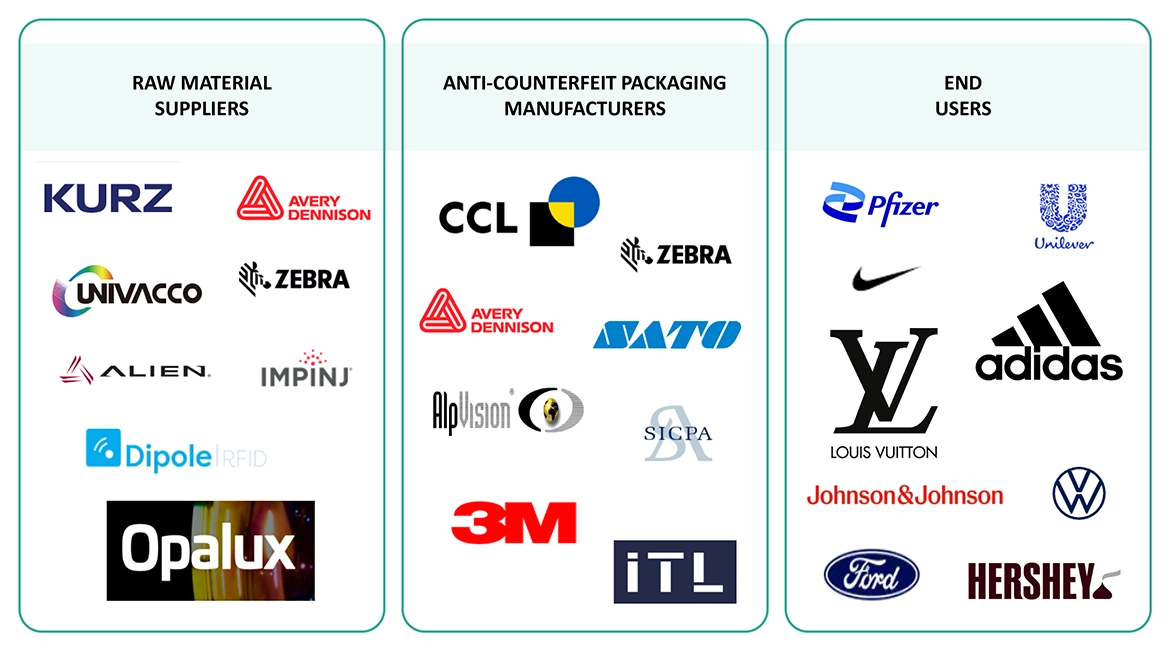
Companies active in different areas include SICPA, Authentix, Avery Dennison, Systech, Scantrust, AlpVision, Applied DNA Sciences, Zebra Technologies, CCL Industries, and 3M. They do not all provide identical technologies or services.
Are QR Codes Effective Against Counterfeit Products?
They can be useful when implemented as part of a secure authentication system. A basic QR code that simply points to a website is easy to reproduce, so the security architecture behind the identifier matters.
Is RFID an Anti-Counterfeiting Technology?
RFID can contribute to anti-counterfeiting by providing product identification and supply-chain visibility. However, RFID itself should not automatically be considered proof that a product is genuine.
Does Blockchain Prevent Counterfeit Products?
No. Blockchain can provide a tamper-resistant record of information, but it does not automatically establish that the physical product associated with that information is genuine.
What Technology Is Used to Authenticate Pharmaceutical Products?
Pharmaceutical authentication can involve serialization, digital verification, track-and-trace systems, tamper-evident packaging, and covert or overt security features. The exact technology depends on the market, product, and applicable regulations.
Can Small Businesses Use Anti-Counterfeiting Technology?
Yes. Smaller businesses do not necessarily need a complex multi-layer system. Depending on the risk, a secure digital identifier, authentication label, serialized QR system, or tamper-evident packaging may provide a practical starting point.
Is a Hologram Enough to Stop Counterfeiting?
Usually, it should not be treated as a complete solution. Holograms can provide a visible security feature, but sophisticated counterfeiters may attempt to reproduce visible characteristics. Combining visible features with covert or digital authentication can provide additional layers.
Final Takeaway
Anti-counterfeiting technology is no longer a single category built around holograms and security labels.
The industry now spans security inks, covert markers, secure QR codes, NFC, RFID, serialization, digital authentication, invisible markings, molecular identification, track-and-trace systems, and connected product identities.
The 10 companies discussed here—SICPA, Authentix, Avery Dennison, Systech, Scantrust, AlpVision, Applied DNA Sciences, Zebra Technologies, CCL Industries and 3M—should therefore not be viewed as a simple ranking.
They represent different approaches to the same broad problem:
How can businesses make products harder to counterfeit and easier to authenticate?
For many organizations, the answer will not be one technology. A combination of physical security, covert authentication, unique digital identity, traceability, and appropriate verification can provide a more resilient approach.
The most important decision is to start with the threat and the business process—not with the technology that happens to be most fashionable in 2026.